Introduction to Marketing
A. Definition of Marketing
Marketing is the process of creating, communicating, delivering, and exchanging offerings that have value for customers, clients, partners, and society at large. It is a comprehensive activity that encompasses market research, product design, pricing, distribution, promotion, and after-sales service.
The American Marketing Association (AMA) defines marketing as:
“The activity, set of institutions, and processes for creating, communicating, delivering, and exchanging offerings that have value for customers, clients, partners, and society at large.”
Key Points:
- Marketing is not just selling or advertising.
- It is about understanding and fulfilling customer needs.
- It involves a relationship between the company and its stakeholders.
B. FEATURES OF MARKETING
Introduction
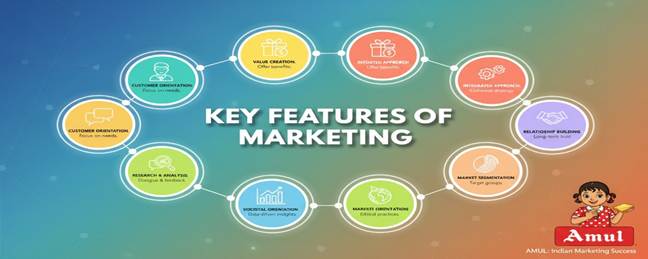
Marketing is far more than just selling or advertising a product. It is a holistic process that involves understanding, creating, and delivering value to customers, as well as maintaining long-term relationships with them. The features of marketing explain the essential characteristics that make marketing an indispensable part of any successful business.
1. Customer Orientation
Explanation:
Marketing starts and ends with the customer. Understanding customer needs, wants, preferences, and behaviors is central to marketing. All activities—from product development to promotion—are designed to satisfy the customer.
Example:
Amazon’s recommendation system uses customer data to personalize shopping experiences, increasing satisfaction and loyalty.
2. Value Creation and Exchange
Explanation:
Marketing is about creating value for customers and facilitating the exchange of that value for money or other benefits. Value is not just in the product, but in the experience, after-sales service, and brand trust.
Example:
Apple creates value by offering high-quality, innovative products and a seamless ecosystem, which customers are willing to pay a premium for.
3. Integrated Approach
Explanation:
Marketing involves the coordination of many activities (product, price, place, promotion) to ensure a unified and effective approach. This integration is known as the marketing mix or the 4Ps.
Example:
Coca-Cola coordinates product launches, pricing strategies, wide distribution, and global advertising for consistent brand messaging.
4. Continuous and Dynamic Process
Explanation:
Marketing is ongoing and must adapt to changing consumer preferences, competitor actions, and technological advancements. It requires continuous market research and feedback.
Example:
Netflix regularly updates its content library and recommendation algorithms in response to viewer data and trends.
5. Relationship Building
Explanation:
Modern marketing emphasizes building long-term relationships with customers, rather than focusing only on one-time sales. Relationship marketing aims to create customer loyalty and advocacy.
Example:
Starbucks maintains customer relationships through its rewards program, personalized offers, and mobile app engagement.
6. Market Segmentation and Targeting
Explanation:
Not all customers are the same. Marketers segment the market based on demographics, geography, psychographics, or behavior, and then target specific segments with tailored products and messages.
Example:
Maruti Suzuki targets different segments with various models: Alto for entry-level buyers, Swift for youth, and Ciaz for the premium segment.
7. Societal Orientation
Explanation:
Marketing today is expected to balance company profits with consumer needs and societal welfare. This includes ethical responsibility, sustainability, and social impact.
Example:
Unilever’s “Sustainable Living” campaign promotes eco-friendly products and responsible consumption.
8. Two-Way Communication
Explanation:
Marketing is a dialogue, not a monologue. Companies now engage in two-way communication with customers through social media, reviews, and feedback channels.
Example:
Zomato uses Twitter and Instagram not just for announcements, but also to listen and respond to customer feedback instantly.
9. Research and Analysis
Explanation:
Decisions in marketing are based on systematic research and data analysis. This helps in understanding the market environment, competition, and consumer trends.
Example:
FMCG companies like ITC use extensive market surveys before launching new products.
10. Profit and Non-Profit Orientation
Explanation:
While most marketing is profit-driven, NGOs and government bodies also use marketing principles to promote ideas, causes, or behavior changes.
Example:
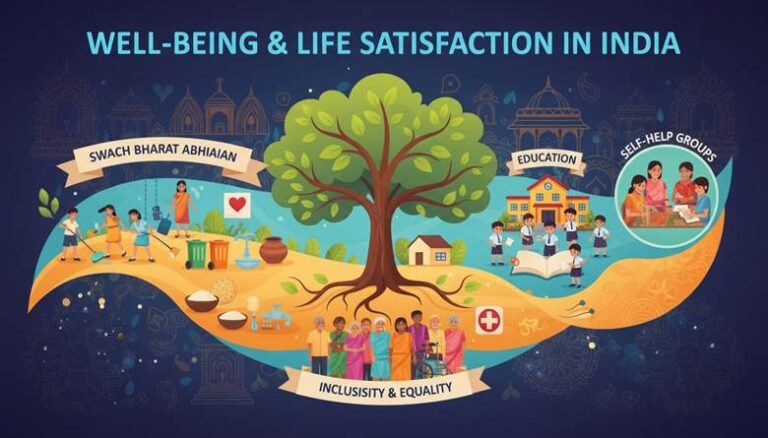
The “Swachh Bharat Abhiyan” campaign in India uses marketing tools (ads, celebrity endorsements) to promote cleanliness.
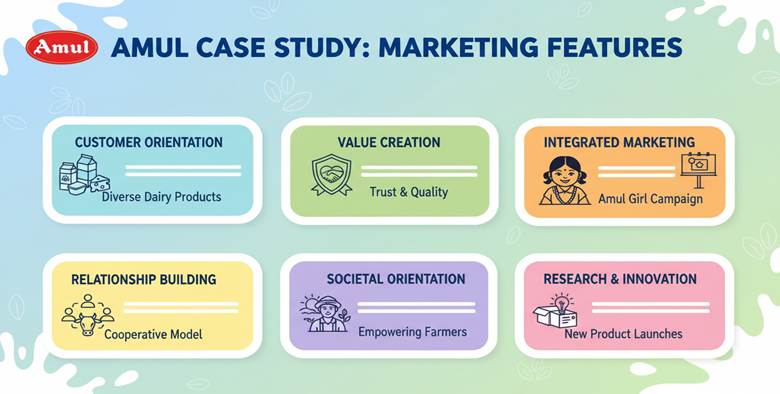
Case Study: Amul—A Model of Marketing Excellence
Background:
Amul, an Indian dairy cooperative founded in 1946, has become one of the most recognized brands in India. Its success is attributed to the effective application of marketing features.
Customer Orientation
Amul’s wide range of products addresses the varied needs of Indian consumers, from urban to rural, and from children to the elderly. Its pricing strategy ensures affordability without compromising on quality.
Value Creation & Exchange
Amul’s value proposition is high-quality, affordable dairy products. The value exchange is not just monetary—the brand offers trust, consistent quality, and nostalgia.
Integrated Approach
Amul’s legendary “Amul Girl” advertising campaign is consistent across TV, print, and digital, ensuring a unified message. Distribution is extensive, reaching even remote villages.
Continuous Process
Amul constantly innovates—launching new products like flavored milk, ice creams, and health drinks to suit changing tastes and health trends.
Relationship Building
Amul’s relationship with farmers is as strong as with consumers. Its cooperative model ensures fair prices to milk producers, building loyalty and trust on both fronts.
Societal Orientation
Amul’s business model empowers rural farmers, particularly women, by giving them a steady source of income and making them stakeholders in the company’s success.
Two-Way Communication
Amul actively engages with its audience on social media, responding to trends and consumer feedback with witty, topical ads.
Market Segmentation and Targeting
Amul segments by product use (cooking, direct consumption, health) and targets different age groups and regions, tailoring products and campaigns accordingly.
Research and Analysis
Before launching any new product, Amul conducts in-depth research on consumer preferences, regional tastes, and market demand.
Results and Impact
Amul is not only the market leader in the Indian dairy sector, but also a beloved brand with a positive societal impact. Its success showcases the power of customer focus, value creation, continuous innovation, and responsible marketing.
Conclusion
The features of marketing—customer orientation, value creation, integration, dynamism, relationship building, research, and societal orientation—are essential to building successful brands and organizations. Amul’s case exemplifies how consistent application of these features leads to both business success and positive social change. By studying such examples, students and professionals can learn to apply these features to a variety of industries and marketing challenges.