Risk management and contingency planning
Introduction
Film production, whether for cinema, streaming, or television, is an inherently risky venture. Creative ambitions must balance with logistical, financial, technical, and legal realities. Unforeseen events—ranging from bad weather to actor illness, equipment failure, or political unrest—can disrupt even the most carefully made plans. That’s why effective risk management and contingency planning are at the heart of successful project management in the media industry.
Understanding Risk Management in Film
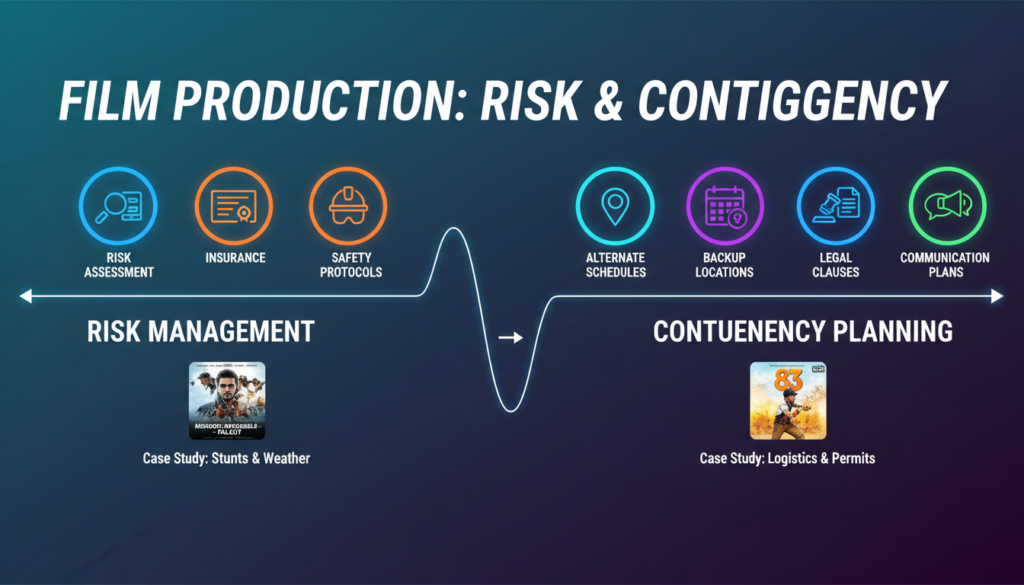
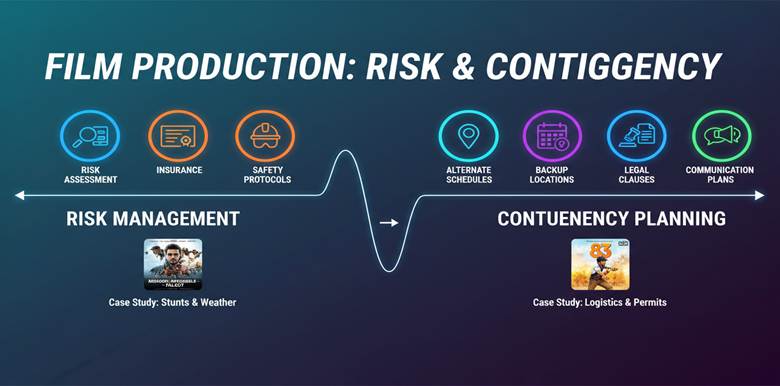
Risk management is the systematic process of identifying, assessing, and mitigating potential problems that could negatively impact a film project. It involves anticipating what might go wrong, evaluating the likelihood and impact, and developing strategies to reduce or cope with these risks.
Contingency planning is the process of creating actionable backup plans (“Plan B”) for when risks materialize, ensuring that the production can adapt and continue with minimal disruption.
Types of Risks in Film Production
- Financial Risks: Budget overruns, funding withdrawal, and unexpected expenses.
- Schedule Risks: Delays due to weather, cast/crew illness, equipment breakdown, or location unavailability.
- Legal and Compliance Risks: Permit issues, copyright disputes, contract breaches, regulatory changes.
- Technical Risks: Equipment failure, data loss, VFX challenges.
- Creative Risks: Script rewrites, loss of creative personnel, and negative test screenings.
- Reputational Risks: Controversies, on-set accidents, community backlash.
- Environmental and Force Majeure Risks: Natural disasters, pandemics, and political unrest.
Risk Management Process
- Risk Identification:
List all potential risks (e.g., monsoon rains in Mumbai, key actor falling sick, local protests). - Risk Assessment:
Evaluate the likelihood (how probable?) and impact (how severe?) of each risk. - Mitigation Strategies:
Take preventative measures—schedule outdoor shoots in dry months, insure equipment, secure permits early, and have medical staff on set. - Contingency Planning:
Develop specific plans for what to do if a risk event occurs—alternate locations, backup actors and crew, additional budget for reshoots, and flexible contracts. - Monitoring and Review:
Continuously monitor risk factors and update contingency plans as production evolves.
Example: Risk Management in “Sooryavanshi” (2021, India)
The Akshay Kumar starrer “Sooryavanshi” was scheduled for release in 2020, but the COVID-19 pandemic led to nationwide lockdowns. The producers had to postpone the release multiple times, adapt to new safety protocols for post-production work, and eventually opt for a hybrid release strategy (theatrical and digital platforms). Their contingency planning minimized financial losses and ensured a successful launch when theaters reopened.
Key Tools and Tactics in Film Risk Management
- Insurance:
Most productions obtain insurance for cast, crew, equipment, and locations. “Completion bonds” guarantee that the film will be finished, even if costs rise. - Flexible Scheduling:
Shooting schedules are designed with buffer days for weather or technical delays. Call sheets may include alternate scenes for unexpected changes. - Legal Safeguards:
Contracts include force majeure clauses, clear deliverables, and dispute resolution terms. - Health and Safety Protocols:
On-set medical teams, safety officers, and compliance with local regulations. - Data Security:
Regular backups of digital footage and VFX assets.
Case Study: Risk Management and Contingency Planning in “Mission: Impossible – Fallout” (2018, Hollywood)
Background:
“Mission: Impossible – Fallout,” starring Tom Cruise, was an international action film with a demanding production schedule and high physical risks due to complex stunts and multiple global locations.
Identified Risks:
- Actor injury during dangerous stunts.
- Weather disruptions in outdoor locations (e.g., Paris, New Zealand).
- Equipment failure during aerial and motorcycle sequences.
- Scheduling conflicts with international cast and crew.
- Potential loss of footage due to technical difficulties.
Mitigation and Contingency Planning:
- Stunt Safety:
Extensive rehearsal, world-class stunt coordinators, and on-set medics. Every high-risk stunt was storyboarded and tested before actual filming. - Insurance:
Comprehensive policies covering injuries, production delays, and equipment loss. - Alternate Schedules:
The schedule included buffer days for delays and backup scenes that could be shot if weather or other problems halted primary shooting. - Data Security:
Multiple on-location backups for all footage. In some cases, footage was digitally transmitted to secure servers daily. - Legal Compliance:
Local legal teams in each country secured permits and ensured regulations were met.
Incident and Response:
During filming, Tom Cruise broke his ankle while jumping between buildings in London. This unforeseeable injury halted production for several weeks—a major schedule and financial threat. The contingency plan was immediately enacted:
- The insurance policy covered the cost of the shutdown.
- The production team used the downtime to advance post-production work, edit existing footage, and plan marketing.
- Some secondary scenes not requiring Cruise were shot with other cast members, making use of available resources.
- Legal and PR teams managed public communication to avoid negative speculation.
Outcome:
Despite the major setback, the film was completed without exceeding the overall budget or missing the planned release window. “Mission: Impossible – Fallout” went on to become a box office hit and was praised for its action sequences, including those filmed after Cruise’s recovery.
Indian Example: “83” (2021)
Background:
The cricket drama “83,” starring Ranveer Singh, recreated India’s 1983 World Cup victory. Filming took place in India and the UK, with large crowd scenes and international locations.
Risks and Contingencies:
- Weather Uncertainty: UK outdoor matches were scheduled during the driest months. Indoor backup locations were secured in case of rain.
- COVID-19 Restrictions: Production faced several delays and new health protocols. The producers established a COVID-19 task force, onboarded medical advisors, and created isolation plans for cast and crew.
- Logistics: Moving equipment and people internationally risked customs delays. The production hired experienced line producers in the UK to handle local logistics and legal compliance.
- Data Safety: Footage was backed up on location and regularly sent to Mumbai editors.
Incident and Response:
When the pandemic shut down international travel, the Indian crew in London was quickly repatriated, and post-production shifted to remote work. The release was postponed, and marketing strategies were updated to keep fan interest alive during delays.
Outcome:
Despite delays, “83” was released successfully to critical acclaim, demonstrating how contingency planning can save a project from unforeseen global challenges.
Conclusion
Risk management and contingency planning are indispensable in film project management. Whether it’s a pandemic, weather, injury, or logistical hurdle, anticipating risks and preparing adaptive strategies makes the difference between chaos and success. Recent films like “Sooryavanshi,” “83,” and “Mission: Impossible – Fallout” reveal that with foresight, flexibility, and a strong safety net, filmmakers can overcome even the most daunting obstacles—delivering compelling stories to audiences around the world.