Introduction
Human values are the guiding principles, ideals, and beliefs that shape individual behavior and collective social life. They serve as the foundation for harmonious personal development and healthy social interactions. In a diverse society like India, where cultures, religions, and traditions intermingle, understanding and practicing human values is crucial for achieving holistic development at both the individual and community levels.
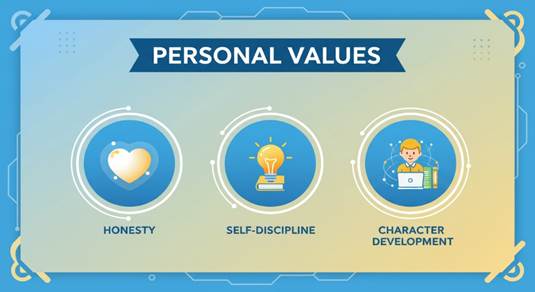
What Are Human Values?
Human values are ethical benchmarks that help individuals distinguish right from wrong and guide their thoughts, feelings, and actions. Common human values include:
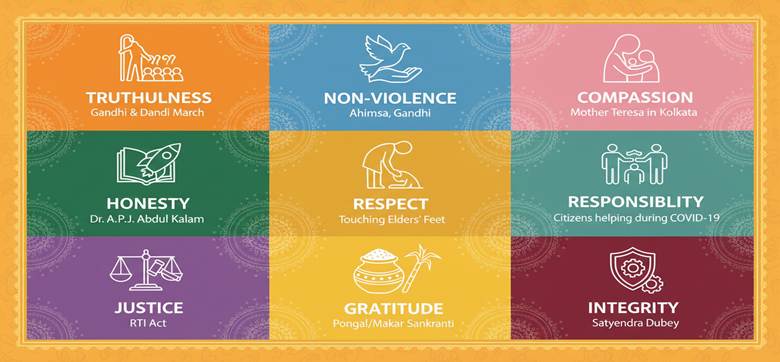
1. Truthfulness (Satya)
- Explanation: Telling the truth, being honest in words and actions, and standing by facts.
- Example: Mahatma Gandhi made “Satya” (truth) the foundation of his philosophy and the freedom struggle. The Salt March (Dandi March) was a non-violent protest based on truthful resistance against unjust British laws.
2. Non-violence (Ahimsa)
- Explanation: Avoiding harm to others in thought, word, and deed; resolving conflicts peacefully.
- Example: During India’s freedom movement, Gandhi’s use of Ahimsa led to peaceful protests and civil disobedience, such as the Quit India Movement, inspiring global leaders like Martin Luther King Jr.
3. Compassion (Karuna)
- Explanation: Feeling empathy for others’ suffering and acting to relieve it.
- Example: Mother Teresa dedicated her life to caring for the poor, sick, and dying in Kolkata, embodying compassion through her Missionaries of Charity.
4. Honesty
- Explanation: Being truthful, transparent, and free from deceit in all dealings.
- Example: Dr. A.P.J. Abdul Kalam, India’s former President, was known for his honesty and simplicity. His refusal to misuse government facilities set a public example.
5. Respect
- Explanation: Valuing others’ dignity, rights, and beliefs, regardless of differences.
- Example: Touching elders’ feet is a common gesture in Indian culture, showing respect for elders and teachers. Festivals like Raksha Bandhan emphasize respect between siblings.
6. Responsibility
- Explanation: Being accountable for one’s actions and fulfilling duties towards family, society, and the nation.
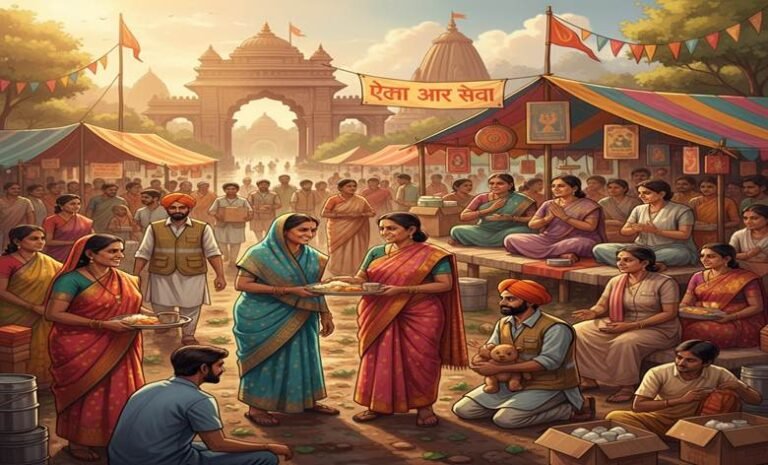
- Example: During the COVID-19 pandemic, Indian citizens volunteering to distribute food and essentials, or following lockdown norms, demonstrated responsibility towards community welfare.
7. Justice
- Explanation: Treating all individuals fairly, giving everyone their due rights, and opposing injustice.
- Example: The Right to Information Act (RTI) empowers Indian citizens to demand accountability from officials, promoting transparency and justice in governance.
8. Gratitude
- Explanation: Appreciating what one has received and expressing thanks to others.
- Example: Indian festivals like Pongal and Makar Sankranti are harvest festivals where people express gratitude to farmers, the land, and nature for a good harvest.
9. Integrity
- Explanation: Adhering to strong moral principles, being consistent in values, and not yielding to unethical pressure.
- Example: Satyendra Dubey, an Indian Engineering Service officer, exposed corruption in highway projects. He lost his life for refusing to compromise on integrity, becoming a symbol of courage and uprightness.
These values are often rooted in cultural, spiritual, and philosophical traditions. For instance, Indian scriptures like the Bhagavad Gita, Upanishads, and teachings of Mahatma Gandhi emphasize values such as selflessness, non-violence, and truth.
Summary Table
| Value | Meaning | Indian Example |
| Truthfulness | Honesty in words/actions | Gandhi’s philosophy and Dandi March |
| Non-violence | Avoiding harm, peaceful resolution | Gandhi’s Ahimsa in freedom struggle |
| Compassion | Empathy and helpfulness | Mother Teresa’s work in Kolkata |
| Honesty | Free from deceit, transparent | Dr. Kalam’s public service |
| Respect | Valuing dignity and beliefs of others | Touching elders’ feet, Raksha Bandhan |
| Responsibility | Fulfilling duties to others/society | Citizen action during COVID-19 |
| Justice | Fairness, giving due rights | Right to Information Act (RTI) |
| Gratitude | Expressing thanks, appreciation | Pongal, Makar Sankranti harvest festivals |
| Integrity | Moral uprightness, consistency | Satyendra Dubey’s stand against corruption |
Significance of Human Values in Personal Life
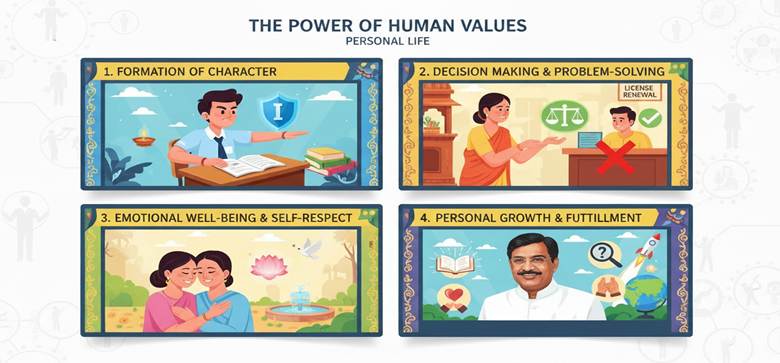
1. Formation of Character
Values form the bedrock of character. An individual guided by values such as honesty, self-discipline, and respect develops positive traits and earns the trust and admiration of others.
Example:
A student who resists the temptation to cheat in exams, even when others are doing so and there is no risk of being caught, demonstrates integrity—a core human value.
2. Decision Making and Problem-Solving
Values provide a framework for making tough choices. When faced with dilemmas, individuals with strong values can refer to their internal moral compass.
Example:
Choosing not to pay a bribe for a driving license reflects the value of honesty and respect for law, even if it means facing inconvenience.
3. Emotional Well-being and Self-respect
Living in alignment with one’s values leads to a sense of inner peace and self-respect. Conversely, acting against these values causes guilt and stress.
Example:
A person who forgives rather than seeks revenge finds relief from anger and emotional turmoil.
4. Personal Growth and Fulfillment
Values like curiosity, perseverance, and gratitude encourage continuous learning and self-improvement.
Example:
Dr. A.P.J. Abdul Kalam’s humility, curiosity, and dedication to service made him not just a renowned scientist, but also “the People’s President” of India.
Significance of Human Values in Social Life
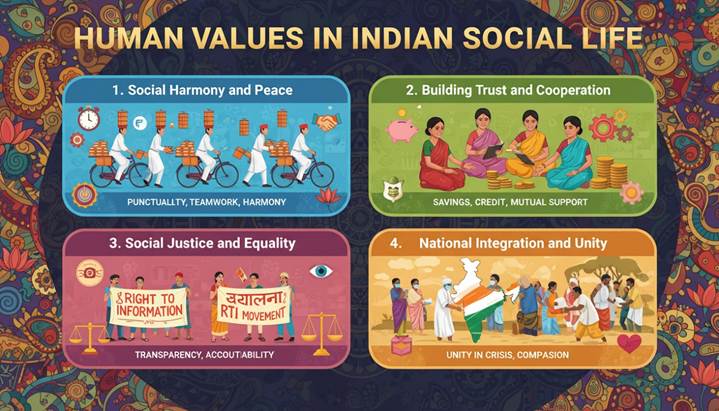
1. Social Harmony and Peace
Values such as tolerance, empathy, and justice are essential for coexistence in a pluralistic society.
Case Study:
The Dabbawalas of Mumbai—This world-renowned lunchbox delivery service is based on values like punctuality, reliability, and teamwork. Despite cultural, religious, and linguistic diversity among its workers, their shared values ensure trust and harmony, leading to an extremely low error rate and international acclaim.2. Building Trust and Cooperation
In social relationships, values like trustworthiness, fairness, and respect foster cooperation and collective progress.
Example:
Self-help groups (SHGs) in rural India empower women by promoting values of mutual trust and collective responsibility, enabling them to save money, access credit, and support one another.
3. Social Justice and Equality
Values inspire individuals and groups to challenge injustice and promote equality.
Case Study:
The Right to Information (RTI) Movement—Grassroots activists in Rajasthan, led by Aruna Roy, fought for the right to transparency in governance. Their value-driven activism resulted in the RTI Act, empowering citizens to demand accountability and fight corruption.
4. National Integration and Unity
In a nation as diverse as India, shared values like patriotism, secularism, and respect for diversity are necessary for unity and national integration.
Example:
During national crises—such as the 2004 tsunami or the COVID-19 pandemic—Indians from all backgrounds came together, setting aside differences to help those in need, demonstrating compassion and solidarity.
How Are Human Values Developed and Sustained?
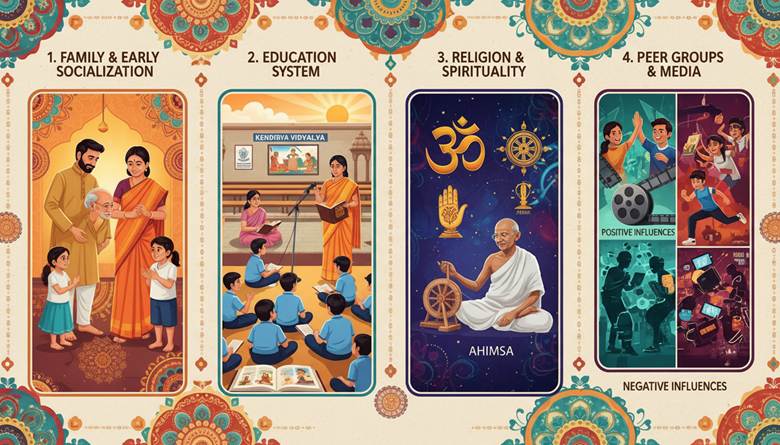
1. Family and Early Socialization
Families are the primary transmitters of values. Children observe and learn from the behavior of parents, elders, and siblings.
Example:
Parents teaching children to greet elders, share with siblings, or help those in need instill values from a young age.
2. Education System
Schools and colleges play a vital role in values education. Moral science classes, value-based curricula, and role-model teachers reinforce ethical behavior.
Case Study:
The Kendriya Vidyalayas and other Indian schools often conduct morning assemblies with value-based stories and talks, promoting honesty, respect, and patriotism among students.
3. Religion and Spirituality
Most religions teach universal values such as compassion, honesty, and forgiveness.
Example:
The principle of Ahimsa (non-violence) is common to Hinduism, Buddhism, and Jainism, and has been a guiding value for Indian leaders like Gandhi.
4. Peer Groups and Media
Friends, social networks, and media significantly influence values—both positively and negatively.
Example:
Positive role models in films, literature, and sports can inspire values like perseverance, teamwork, and fairness. Conversely, exposure to negative influences can erode these values.
Challenges to Human Values in Contemporary Society
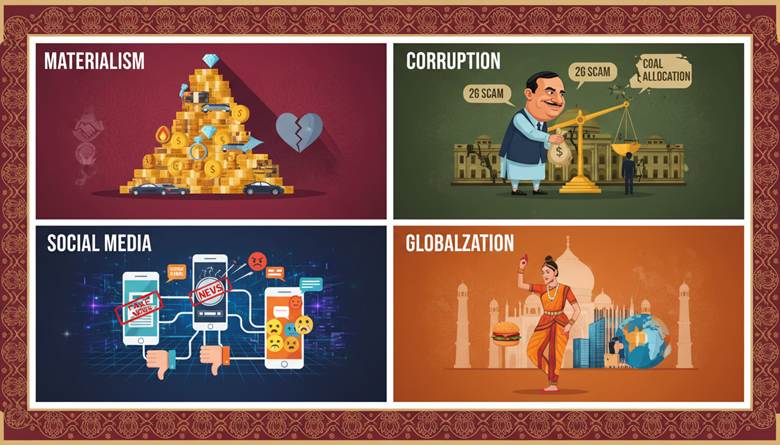
Despite their importance, human values are increasingly under strain due to:
- Materialism: The pursuit of wealth and status often overshadows compassion and honesty.
- Corruption: Erosion of values in public life leads to mistrust and social decay.
- Social Media: The spread of misinformation, intolerance, and cyberbullying can undermine empathy and respect.
- Globalization: While it brings exposure to diverse values, it can also cause a loss of cultural identity and traditional values.
Case Study:
Corruption in Public Life—Scams like the 2G spectrum or coal allocation scandals in India show how the neglect of values like honesty and responsibility can harm society at large.
Reviving and Promoting Human Values
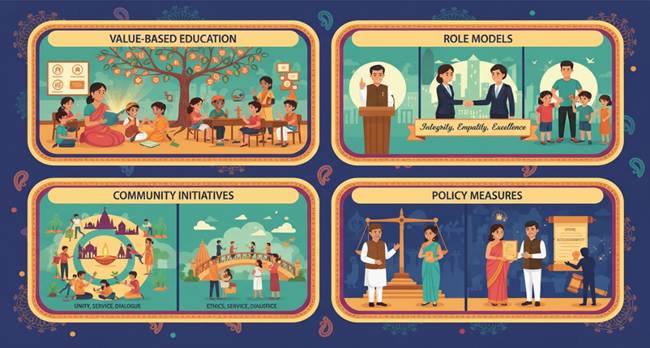
- Value-based Education: Integrate human values into the curriculum at all levels of education. Use storytelling, role-play, service-learning, and discussions to make values relatable.
- Role Models: Leaders in politics, business, sports, and media should model ethical behavior.
- Community Initiatives: Encourage volunteering, community service, and interfaith dialogue to foster empathy and social cohesion.
- Policy Measures: Laws and policies should reward ethical behavior and penalize malpractices.
Conclusion
Human values are the foundation of a person’s character and the bedrock of a harmonious society. In personal life, they guide moral choices, shape character, and nurture fulfillment. In social life, they promote trust, justice, and collective progress. Indian society, with its rich heritage and diversity, both challenges and demonstrates the transformative power of values. By reinforcing these values through family, education, role models, and community action, India can continue to progress towards holistic development, social harmony, and inclusive growth.