Introduction
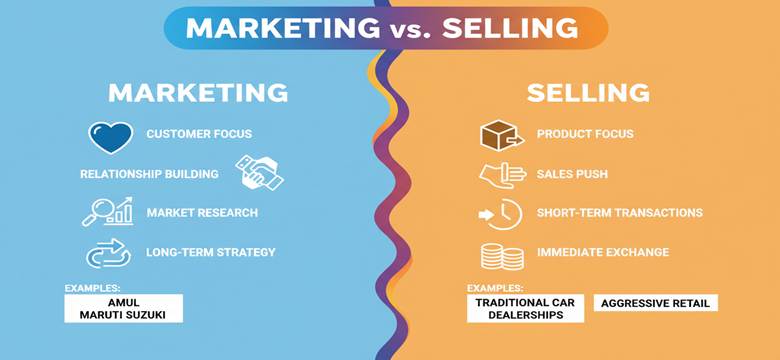
While often used interchangeably, marketing and selling are two distinct concepts in business. Understanding the difference is crucial for anyone aspiring to build long-lasting brands and successful organizations. Marketing is a broader, customer-oriented process, whereas selling is a narrower, product-focused activity. Let’s explore their differences, supported with real-world examples and case studies from both Indian and international brands.
Definitions
Marketing:
Marketing is a comprehensive process that starts with identifying customer needs, creating value through products or services, communicating that value, delivering satisfaction, and building long-term relationships. Marketing involves market research, product development, pricing, distribution, promotion, and after-sales service. The focus is on customer satisfaction and relationship building.
Selling:
Selling is the activity of persuading or influencing a customer to buy a product or service. It is a part of marketing, concerned mainly with the transfer of goods or services from the seller to the buyer, often through direct or indirect sales techniques. The focus is on increasing sales volume.
Key Differences
| Aspect | Marketing | Selling |
| Focus | Customer needs and satisfaction | Product features and sales targets |
| Approach | Pull (creating demand) | Push (convincing to buy) |
| Orientation | Long-term relationship, brand loyalty | Short-term, transaction-based |
| Starting Point | Market research and consumer insights | Product development |
| End Goal | Customer delight and retention | Sale completion |
| Strategy | Integrated (4Ps/4Cs, customer journey) | Stand-alone sales tactics |
| Process | Starts before production, continues after sale | Starts after production, ends at sale |
Example: Indian Brand—Maruti Suzuki
Marketing Approach:
Maruti Suzuki is India’s largest car manufacturer. Instead of just pushing cars, it invests heavily in market research, after-sales service, and customer feedback. Maruti identifies what Indian families need—fuel efficiency, affordable pricing, easy maintenance, and widespread service centers. It uses advertising, roadshows, and digital campaigns to create awareness and build trust, often positioning its cars as “family cars for India.”
Selling Approach:
A car dealer employing a selling approach would focus on convincing a walk-in customer to buy whichever model is in stock, offering discounts, and pushing for immediate sales, even if the car isn’t the best fit for the customer’s needs.
Result:
Maruti Suzuki’s marketing focus has made it a market leader, with high customer loyalty and repeat purchases.
______________________________________________________________________________
Example: Foreign Brand – Apple
Marketing Approach:
Apple is renowned for its marketing. Before launching a product, it studies customer needs (design, usability, innovation). It creates anticipation through teasers, product launches, and storytelling. Apple focuses on building an ecosystem (iPhone, iPad, Mac, Apple Watch) and an emotional connection with users. The company continues engagement through seamless customer support and updates.
Selling Approach:
A pure selling focus would see Apple stores just trying to clear inventory by pushing unsold models, offering discounts, and using aggressive sales pitches without regard for customer fit or satisfaction.
Result:
Apple’s marketing has built one of the world’s most loyal customer bases, allowing it to charge premium prices and maintain high brand equity.
Case Study 1: Amul (India) – Marketing Excellence
Background:
Amul, the iconic dairy cooperative, is famous for its witty, topical ad campaigns and a customer-first approach.
Marketing Approach:
- Product Development: Introduces new products (e.g., Amul Kool, ice cream) based on consumer feedback and market trends.
- Brand Building: The Amul Girl campaigns build emotional resonance and keep the brand top-of-mind.
- Distribution: Ensures products reach even the remotest villages, meeting customer needs everywhere.
- Customer Focus: Affordable pricing, quality assurance, and social impact (uplifting rural farmers).
Selling Approach:
A selling-driven dairy company might focus only on pushing milk or butter stocks through discounts or bulk deals, with little regard for customer preference, innovation, or brand building.
Impact:
Amul’s marketing has made it a beloved brand, with the highest market share and customer trust in India’s dairy sector.
Case Study 2: Tesla (International) – Marketing vs. Selling
Background:
Tesla, the US-based electric vehicle (EV) company, has disrupted the global automobile market.
Marketing Approach:
- Customer Orientation: Focuses on solving environmental concerns, providing sustainable yet high-performance vehicles.
- Innovative Product: Incorporates customer feedback into software updates and new features.
- Direct-to-Consumer Model: Sells cars online, skipping traditional dealerships, simplifying the buying process.
- Community Building: Engages owners through events, referral programs, and over-the-air updates.
Selling Approach:
Traditional automakers often rely on dealerships, which may prioritize moving unsold inventory, offering discounts, or upselling additional features, rather than focusing on each customer’s unique needs.
Impact:
Tesla’s marketing has created a passionate global community, high pre-order volumes, and brand advocates—often without spending much on traditional advertising.
Comparative Table: Marketing vs. Selling
| Scenario | Marketing-Oriented Approach | Selling-Oriented Approach |
| Automobile Sales | Maruti Suzuki analyzes customer needs, designs cars accordingly, builds service networks, and uses storytelling ads | A dealer pushes whatever car is in stock, offers discounts, and focuses on closing the sale |
| Technology Products | Apple studies user behavior, launches innovative products, invests in branding, and supports customers post-sale | A store tries to sell old models with aggressive promotions and little concern for fit |
Key Takeaways
- Marketing is about understanding and serving customer needs, building brands, and fostering relationships.
- Selling is about persuading customers to buy what the company has produced, with a narrower focus on immediate sales.
- Marketing starts much before the product is made and continues long after the sale, while selling is just one part of the overall marketing process.
- Brands like Maruti Suzuki, Amul, Apple, and Tesla succeed because they focus on marketing—not just selling—building lasting value for customers and society.
Conclusion
Marketing and selling may both aim to generate revenue, but their approaches and impacts are fundamentally different. Marketing is holistic, strategic, and customer-driven, leading to long-term success and brand loyalty. Selling is tactical, product-driven, and short-term focused. The most successful Indian and international brands are those that prioritize marketing as the core of their business philosophy.