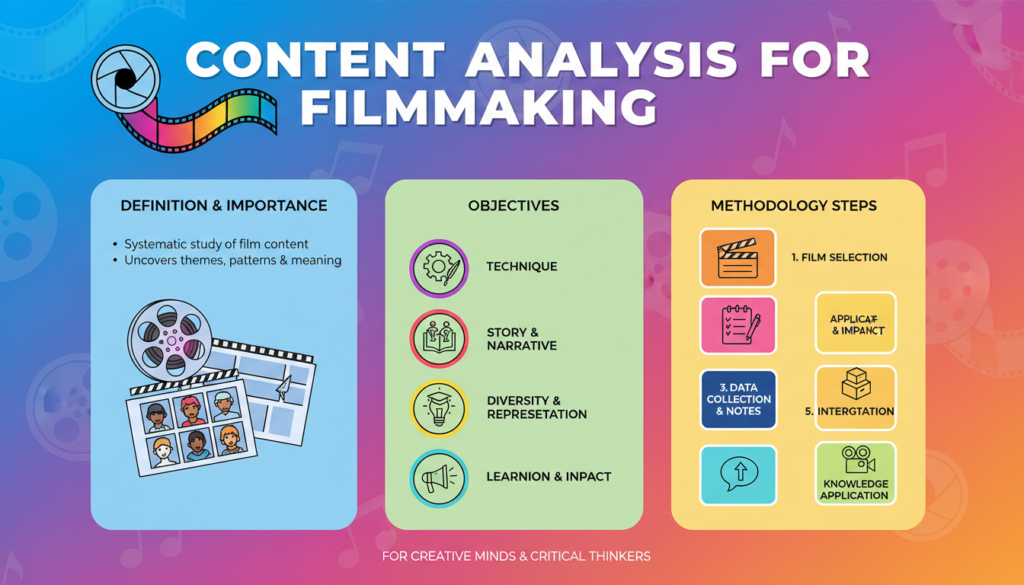
Content analysis for film maker
CONTENT ANALYSIS
To make learners able to analyze content to help them produce a better content.
Introduction to Content Analysis
Content analysis is a systematic research technique that helps filmmakers, critics, and scholars interpret the meanings, themes, and patterns within cinematic works. In the context of filmmaking, it involves breaking down films into their core components—narrative, visuals, characters, sound, and more—to understand how stories are constructed and how they affect audiences. By mastering content analysis, aspiring filmmakers can critically assess films, identify strengths and weaknesses, and apply these insights to create impactful content.
Content analysis is particularly valuable for students, as it:
- Develops a critical eye for storytelling and technical aspects.
- Reveals underlying social, cultural, and political messages.
- Inspires innovation through the study of successful films.
Objectives of Content Analysis for Film Makers
- To understand core cinematic techniques and their effects.
- To identify narrative and visual patterns that engage audiences.
- To evaluate representation, diversity, and inclusivity in film.
- To learn from successful films and avoid common pitfalls.
- To apply analytical insights to one’s own creative projects.
Methodology: How to Conduct Content Analysis
- Film Selection: Choose films with varied genres, themes, and cultural backgrounds.
- Criteria Definition: Decide what aspects to analyze (e.g., narrative structure, cinematography, character development, social commentary, sound design).
- Data Collection: Watch the films, take detailed notes, and record observations.
- Categorization: Organize observations into themes or codes (e.g., gender roles, visual motifs).
- Interpretation: Analyze why certain choices were made and their impact.
- Application: Relate insights to your own film-making process.
Case Study 1: Dangal (2016, India)
Overview:
Dangal, directed by Nitesh Tiwari, tells the real-life story of Mahavir Singh Phogat, who trains his daughters to become world-class wrestlers against societal odds.
Content Analysis:
- Theme: Gender empowerment, breaking stereotypes.
- Narrative Structure: Follows a classic hero’s journey with a focus on perseverance and family dynamics.
- Visuals: Authentic rural settings, realistic depiction of wrestling.
- Sound: Folk and motivational tracks reinforce the emotional tone.
- Representation: Challenges patriarchal norms, showcases women’s strength in sports.
Impact:
The film’s success is rooted in its authentic storytelling and strong social message. It inspired discussions on gender roles and became a reference for sports biopics in Indian cinema.
Case Study 2: Gully Boy (2019, India)
Overview:
Directed by Zoya Akhtar, Gully Boy is inspired by the lives of Mumbai street rappers Divine and Naezy. The film delves into urban youth, class struggles, and the power of music as expression.
Content Analysis:
- Theme: Ambition, class divide, self-expression.
- Narrative Structure: Coming-of-age with underdog triumph.
- Visuals: Gritty, realistic frames capturing Mumbai’s slums and vibrant music scenes.
- Sound: Hip-hop soundtrack central to the film’s identity.
- Representation: Shines a light on marginalized communities and youth culture.
Impact:
Gully Boy set a new benchmark for youth-centric cinema in India, introducing rap as a powerful storytelling tool and highlighting social inequalities.
Case Study 3: Queen (2013, India)
Overview:
Vikas Bahl’s Queen follows Rani, a young woman who embarks on a solo honeymoon after her fiancé calls off their wedding.
Content Analysis:
- Theme: Self-discovery, empowerment, independence.
- Narrative Structure: Heroine’s journey, transformation through adversity.
- Visuals: Contrasts between India and Europe, use of color and setting to mirror Rani’s growth.
- Sound: Uplifting, playful, supports the film’s tone.
- Representation: Redefines female protagonists in Bollywood, promotes individuality.
Impact:
The film’s focus on a woman’s journey, humor, and relatable storytelling made it a cultural phenomenon, influencing the portrayal of women in Indian cinema.
Case Study 4: The Dark Knight (2008, Hollywood)
Overview:
Directed by Christopher Nolan, The Dark Knight is a superhero film that explores the moral complexities of justice, heroism, and chaos.
Content Analysis:
- Theme: Good vs. evil, moral ambiguity, societal order.
- Narrative Structure: Multi-layered, with intertwining character arcs.
- Visuals: Use of shadows, IMAX technology, realistic action sequences.
- Sound: Iconic score by Hans Zimmer adds tension and depth.
- Representation: Joker as an agent of chaos, blurring lines between hero and villain.
Impact:
The film’s nuanced approach to heroism and villainy set it apart in the superhero genre, influencing countless films and earning critical acclaim for its depth.
Case Study 5: Parasite (2019, South Korea/Hollywood)
Overview:
Directed by Bong Joon-ho, Parasite is a dark social satire about class disparity, family, and ambition.
Content Analysis:
- Theme: Class divide, social mobility, deception.
- Narrative Structure: Blends drama, thriller, and dark comedy.
- Visuals: Clever use of space (basement vs. mansion), symbolic imagery.
- Sound: Minimalist, heightens suspense.
- Representation: Sharp social commentary, dynamic character roles.
Impact:
Parasite became the first non-English film to win Best Picture at the Oscars, breaking barriers and sparking conversations on global cinema and inequality.
Comparative Lessons from Indian and Hollywood Films
- Narrative Techniques: Both industries use the hero’s journey but differ in cultural context and style.
- Representation: Indian films often focus on family and society; Hollywood explores individualism and moral ambiguity.
- Visual Storytelling: Hollywood tends to innovate with technology, while Indian films emphasize color and music.
- Audience Engagement: Both industries have global appeal but cater to different cultural sensibilities.
How to Apply Content Analysis to Your Project
- Select a Theme: Focus your analysis (e.g., gender roles, social justice, innovation).
- Choose Films: Pick 2–3 Indian and 2–3 global films relevant to your theme.
- Set Criteria: Decide what you’ll examine—narrative, visuals, sound, representation.
- Watch & Note: Take detailed notes, mark key scenes, and identify patterns.
- Compare & Contrast: Look for similarities and differences in storytelling and technique.
- Draw Lessons: Summarize insights and suggest how these can influence your own filmmaking.
Example Project Outline
- Title Page
- Project Title, Name, Course, Date
- Introduction
- Purpose and importance of content analysis in film
- Methodology
- How films were selected and what was analyzed
- Case Studies
- Detailed analysis of each film
- Comparative Discussion
- What can be learned from these films
- Application
- How these findings inform your own film project
- Conclusion & Bibliography
Dangal: A Comprehensive Content Analysis
Student Project
Introduction
Cinema holds a unique place in Indian culture, often reflecting and shaping societal values. Among the many films that have left an indelible mark on the Indian psyche, Dangal (2016) stands out for its powerful message of gender empowerment, its authentic portrayal of rural India, and its universally relatable story of perseverance against all odds. Directed by Nitesh Tiwari, Dangal is more than just a sports biopic; it is a celebration of breaking stereotypes, challenging societal norms, and highlighting the importance of family support in achieving extraordinary success.
This project aims to present an in-depth content analysis of Dangal, exploring its themes, narrative structure, visual and sound design, representation, and cultural impact. Through this analysis, students of film studies can gain insights into how content can be crafted to inspire change and connect deeply with audiences.
Film Overview
Dangal narrates the extraordinary journey of Mahavir Singh Phogat, a former wrestler who, unable to fulfill his own dream of winning a gold medal for India, resolves to realize this dream through his daughters, Geeta and Babita. Set in the conservative heartland of Haryana, the film follows the Phogat family as they battle social prejudices, gender stereotypes, and personal hardships in their quest for excellence in the male-dominated sport of wrestling.
Content Analysis
1. Theme: Gender Empowerment and Breaking Stereotypes
At its core, Dangal is a film about empowerment. It addresses deep-rooted gender biases by depicting young women excelling in a sport traditionally reserved for men. The film’s narrative directly challenges societal norms that confine women to domestic roles. Mahavir’s determination to train his daughters as wrestlers, despite ridicule from the community, becomes a metaphor for challenging and changing societal expectations.
Key Scenes:
- The community’s mockery of Geeta and Babita’s short hair and wrestling attire.
- The pivotal scene where Geeta wins her first match against a male opponent, symbolizing the breaking of gender barriers.
- The father-daughter confrontations, which highlight generational and ideological conflicts.
2. Narrative Structure: The Hero’s Journey
Dangal follows the classic hero’s journey, a narrative device that resonates across cultures. The film’s structure is linear, charting the Phogat sisters’ journey from childhood to international wrestling championships. The plot is driven by conflict—both internal (self-doubt, familial tension) and external (social resistance, athletic competition).
Stages in the Narrative:
- Call to Adventure: Mahavir’s realization that his daughters have wrestling potential.
- Trials and Preparation: Grueling training, resistance from family and society.
- Transformation: Geeta and Babita’s victories in local and national championships.
- Climax: Geeta’s final match at the Commonwealth Games.
- Resolution: The fulfillment of Mahavir’s dream and national recognition.
This structure ensures sustained audience engagement and emotional investment in the protagonists’ journey.
3. Visuals: Authenticity and Realism
Dangal’s visual storytelling is grounded in authenticity. The film’s cinematography, led by Sethu Sriram, captures the mud-wrestling arenas, rural landscapes, and the everyday life of Haryana with remarkable realism.
Visual Features:
- Use of natural lighting and practical locations to depict village life.
- Color grading that emphasizes earthy tones, reflecting the rustic environment.
- Close-up shots during wrestling matches to convey intensity and emotion.
- Costumes and props that accurately represent the region and sport.
The transformation of the actors, especially Aamir Khan’s physical changes and the rigorous training of the young actresses, adds to the believability and immersive quality of the film.
4. Sound: Folk and Motivational Music
The soundtrack plays a pivotal role in enhancing the film’s emotional depth. Composer Pritam and lyricist Amitabh Bhattacharya blend folk music with motivational anthems that reflect the culture of Haryana and the struggles of the protagonists.
Key Aspects:
- Songs like “Dangal” and “Haanikaarak Bapu” set the tone, combining humor, motivation, and regional flavor.
- Background scores during wrestling matches heighten tension and excitement.
- The use of silence and diegetic sound in emotional scenes underscores moments of vulnerability and triumph.
5. Representation: Challenging Patriarchy and Showcasing Women’s Strength
Dangal is celebrated for its progressive representation of women. Unlike many mainstream films, it places women at the center of the narrative without relegating them to secondary roles. The film also offers a nuanced portrayal of Mahavir—not just as a stern father but as someone willing to change and support his daughters’ ambitions.
Representation Highlights:
- The evolution of Geeta and Babita from reluctant trainees to national icons.
- The shifting dynamics between Mahavir and his daughters, reflecting mutual respect.
- The support of family members, especially the mother and cousin, breaking the stereotype of familial resistance.
Social and Cultural Impact
1. Inspiring Social Change
Dangal’s influence extends beyond the box office. The film sparked national conversations about gender equality, the importance of supporting girls’ education and sports, and the need to challenge regressive traditions. It inspired many families, especially in rural areas, to encourage their daughters to pursue sports and education.
2. Critical and Commercial Success
Dangal became the highest-grossing Indian film of all time, both domestically and internationally, particularly in China where its themes of perseverance and family resonated deeply. It also won numerous awards, including National Film Awards and Filmfare Awards, cementing its status as a modern classic.
3. Reference for Sports Biopics
In the years following Dangal’s release, there was a surge in Indian sports biopics (e.g., Mary Kom, M.S. Dhoni: The Untold Story, Panga), many of which adopted similar narrative and visual styles, and focused on real-life stories of struggle and triumph.
Conclusion
Dangal stands as a compelling example of how cinema can be both entertaining and transformative. Through its authentic storytelling, strong performances, and progressive message, it not only entertains but also educates and inspires. For students of film, Dangal illustrates the power of content analysis in understanding the interplay of theme, narrative, visuals, sound, and representation. Its success underscores the importance of socially relevant cinema and the value of challenging stereotypes.
Suggested Project Structure
- Title Page
- Introduction
- Film Overview
- Content Analysis
- Themes
- Narrative Structure
- Visuals
- Sound
- Representation
- Social and Cultural Impact
- Conclusion
- References
References (Suggested for Further Reading)
- Bordwell, D., & Thompson, K. (2016). Film Art: An Introduction.
- Monaco, J. (2009). How to Read a Film.
- Interviews and articles on the making of Dangal (available in film magazines and online).
- Academic articles on gender representation in Indian cinema.
Avengers: Endgame – A Comprehensive Content Analysis
Introduction
The Marvel Cinematic Universe (MCU) has redefined blockbuster filmmaking with its interconnected narratives, innovative storytelling, and diverse character roster. Released in 2019 and directed by Anthony and Joe Russo, Avengers: Endgame stands as the culmination of over a decade of cinematic storytelling, bringing together characters and plotlines from 21 previous films. The film not only broke box office records but also left an indelible mark on popular culture, serving as a landmark in the history of superhero and event cinema.
This project aims to conduct an in-depth content analysis of Avengers: Endgame, examining its central themes, narrative structure, visual and sound design, character arcs, representation, and cultural impact. The analysis will provide film students with insights into the craftsmanship behind large-scale cinematic storytelling and the emotional resonance that makes such films memorable.
Film Overview
Avengers: Endgame picks up after the catastrophic events of Avengers: Infinity War (2018), where the villain Thanos wiped out half of all life in the universe using the Infinity Stones. The film follows the remaining Avengers and their allies as they grapple with loss, search for redemption, and attempt to reverse Thanos’s actions through a daring time heist. The narrative weaves together personal journeys, epic battles, and the ultimate sacrifice, culminating in a confrontation that shapes the fate of the universe.
Content Analysis
1. Theme: Sacrifice, Legacy, and Hope
At its core, Avengers: Endgame is a film about sacrifice—the willingness to give up everything for the greater good. Each Avenger grapples with personal loss and the burden of failure, yet ultimately chooses to fight for a better future. The film also explores legacy—how heroes are remembered and what they leave behind—and hope, both for the characters and for audiences invested in the MCU’s saga.
Key Scenes:
- Tony Stark’s final sacrifice, echoing his journey from self-absorption to selflessness.
- Captain America returning the Infinity Stones and ultimately passing his shield to Sam Wilson, signifying the passing of the torch and the legacy of heroism.
- Black Widow’s sacrifice on Vormir, highlighting the cost of victory.
- The film’s closing moments, which reflect on grief, healing, and the hope for new beginnings.
2. Narrative Structure: The Epic Resolution
Endgame follows a complex yet tightly woven structure, balancing multiple storylines and timelines:
A. The Three-Act Structure
- Act One: The Avengers deal with defeat and grief. A plan emerges when Ant-Man proposes using quantum mechanics to travel back in time.
- Act Two: The “Time Heist” as the heroes revisit pivotal moments in MCU history to collect the Infinity Stones.
- Act Three: The ultimate battle against Thanos, culminating in Tony Stark’s sacrifice.
B. Time Travel as a Narrative Device The use of time travel allows the film to revisit key events, offering both nostalgia and character development. This device also provides an opportunity for characters to confront their pasts and resolve lingering issues (e.g., Tony meeting his father, Thor seeing his mother).
C. Ensemble Storytelling The film juggles an enormous cast, giving each major character a moment to shine, while maintaining narrative coherence.
3. Visuals: Spectacle and Emotional Resonance
Endgame is a visual triumph, seamlessly blending CGI spectacle with intimate character moments.
Visual Features:
- The contrast between the bleakness of the post-snap world and the vibrant energy of the final battle.
- Iconic scenes such as Captain America wielding Mjolnir, the portals opening to assemble the Avengers, and Iron Man’s final snap.
- Use of color and lighting to reflect emotional states (e.g., muted tones in grief scenes, bright hues in moments of triumph).
- Detailed production design, from the ruined Avengers facility to the alien landscapes.
Cinematography
- Dynamic camera movements during action sequences create a sense of scale and urgency.
- Close-up shots during personal moments (e.g., Tony’s farewell) build emotional intimacy.
4. Sound: Music and Sound Design
The film’s score by Alan Silvestri is integral to its emotional impact, blending recognizable motifs with new themes.
Key Aspects:
- The use of the “Avengers Theme” as a rallying cry during the final battle.
- Subtle, subdued music during scenes of loss and reflection.
- Sound design that heightens action (e.g., the explosive chaos of the battle, the quiet after the snap).
- The use of silence in Tony Stark’s death scene, allowing the emotion to resonate.
5. Character Arcs: Growth and Closure
Endgame provides satisfying closures and growth for its core characters.
A. Tony Stark / Iron Man
- From selfish playboy to self-sacrificing hero.
- Reconciliation with his father, becoming a father himself, and ultimately making the ultimate sacrifice.
B. Steve Rogers / Captain America
- Struggles with his place in the modern world, leads the resistance.
- Returns the Stones and, in a rare act of self-prioritization, chooses a life with Peggy Carter.
C. Natasha Romanoff / Black Widow
- Haunted by her past, seeks redemption.
- Sacrifices herself for the Soul Stone, underscoring her commitment to her found family.
D. Thor
- Grapples with failure and depression.
- Finds acceptance and a new beginning, passing leadership to Valkyrie.
E. Bruce Banner / Hulk
- Integrates his two identities, becoming “Professor Hulk.”
- Provides comic relief and emotional support, playing a key role in the snap reversal.
F. Clint Barton / Hawkeye
- Consumed by grief and darkness after losing his family.
- Finds hope for redemption and is reunited with his family.
6. Representation and Diversity
Endgame is notable for its efforts toward inclusivity, though it has also faced criticism for areas where it could have gone further.
Highlights:
- The all-female superhero moment in the final battle.
- Passing of Captain America’s shield to Sam Wilson, symbolizing a more inclusive future for the MCU.
- Diverse cast of heroes from different backgrounds and identities.
7. Symbolism and Motifs
- The Infinity Gauntlet: Symbolizes ultimate power and the burden of responsibility.
- The Shield and Hammer: Represent legacy, worthiness, and the passing of heroism.
- Portals: Signify unity and the coming together of disparate heroes for a common cause.
8. Impact and Legacy
A. Box Office and Cultural Impact
- Highest-grossing film of all time (as of 2023), grossing over $2.7 billion worldwide.
- Became a cultural touchstone, referencing and influencing other media.
- Sparked debates on fan service, representation, and the future of shared cinematic universes.
B. Influence on Filmmaking
- Set a new standard for interconnected storytelling and franchise building.
- Inspired other studios to pursue large-scale cinematic universes.
C. Emotional and Social Resonance
- Provided closure for millions of fans invested in the MCU’s decade-long narrative.
- Addressed themes of loss, resilience, and hope that resonated beyond the superhero genre, especially in the context of contemporary global uncertainties.
Conclusion
Avengers: Endgame stands as a monumental achievement in modern cinema, not only as a technical and financial marvel but also as a deeply emotional narrative that explores universal themes of sacrifice, legacy, and hope. For film students, the film offers invaluable lessons in balancing spectacle with character-driven storytelling, managing ensemble casts, and constructing satisfying narrative closures.
Through its detailed attention to character arcs, innovative narrative devices like time travel, and commitment to both nostalgia and forward-thinking representation, Endgame serves as a masterclass in blockbuster filmmaking. Its cultural impact ensures it will be studied and referenced for years to come, both as the end of an era and as a beacon for future storytellers.
Suggested Project Structure
- Title Page
- Introduction
- Film Overview
- Content Analysis
- Themes
- Narrative Structure
- Visuals
- Sound
- Character Arcs
- Representation and Symbolism
- Impact and Legacy
- Conclusion
- ReferenceS