Attachment Details FILM-TV-PRODUCTION-ROLES-FOR-NEW-COMERS.
Introduction
The creation of a film or television program is a complex, coordinated effort that transforms an idea into a finished product viewed by millions. While directors and stars often receive public recognition, the backbone of any successful production is the behind-the-scenes leadership and organization provided by the Producer, Line Producer, Production Manager, and Assistant Director. Each of these roles is distinct yet deeply interconnected—responsible for guiding a project from initial concept through to completion. Explores the responsibilities, challenges, and contributions of each role, illustrated by real-world examples and case studies.
1. Producer
Definition and Core Functions
The Producer is a film or television project’s chief architect and driving force, overseeing every stage from development to distribution. Producers are responsible for shaping the creative vision, securing funding, assembling a team, and managing the project’s overall trajectory. They are the primary link between creative, financial, and business aspects, ensuring that the film or show aligns with both artistic aspirations and commercial realities.
Key Responsibilities
- Idea Generation and Rights Acquisition: Producers often originate the concept or secure rights to a script, book, or idea.
- Financing: Responsible for raising the budget, negotiating with investors, studios, or networks, and managing risk.
- Team Assembly: Hires the director, principal cast, and key crew.
- Creative Oversight: Guides the script development, casting, and major creative decisions.
- Project Management: Supervises progress, resolves conflicts, and ensures timely delivery.
- Marketing and Distribution: Develops strategies for promotion and release.
Example
Kathleen Kennedy is one of Hollywood’s most respected producers, known for her work on the “Jurassic Park,” “Indiana Jones,” and new “Star Wars” films. She manages billion-dollar budgets, high-profile directors, and marketing campaigns that reach global audiences.
Case Study: “The Lord of the Rings” (Producer: Barrie M. Osborne)
Barrie M. Osborne was critical in transforming Peter Jackson’s vision for “The Lord of the Rings” trilogy into reality. Osborne secured funding from New Line Cinema, managed relationships with the Tolkien estate, and assembled a world-class creative team. Over several years, Osborne balanced budgetary constraints, scheduling complexities, and daily production challenges in New Zealand. His leadership turned the trilogy into a groundbreaking cinematic achievement, with all three films completed on time and within budget—winning both commercial and critical acclaim, including multiple Academy Awards.
2. Line Producer
Definition and Core Functions
While the Producer handles the overall vision and financing, the Line Producer is the hands-on manager responsible for day-to-day operations. The Line Producer translates creative ideas into practical plans, manages the budget, hires the crew, and ensures all logistical needs are met on set. In essence, the Line Producer is the production’s chief operations officer, overseeing every dollar spent and every detail of the shoot.
Key Responsibilities
- Budgeting: Prepares and manages the production budget, authorizing all expenditures.
- Scheduling: Creates a workable schedule that aligns with creative needs and budgetary constraints.
- Hiring Crew: Recruits department heads (cinematography, art, costume, etc.) and key technical staff.
- Logistics: Arranges locations, equipment rentals, permits, and transportation.
- Problem Solving: Handles emergencies, weather delays, and unexpected challenges.
- Compliance: Ensures union rules, safety regulations, and legal requirements are met.
Example
On blockbuster films like “Avengers: Endgame,” the Line Producer manages vast crews, complex stunts, and enormous budgets, ensuring coordination across multiple units and simultaneous locations.
Case Study: “Slumdog Millionaire” (Line Producer: Christian Colson)
“Slumdog Millionaire” was filmed on location in Mumbai, India—a bustling, unpredictable environment. Line Producer Christian Colson managed everything from casting local children and negotiating with city officials to ensuring safe, efficient shooting in crowded slums. Colson kept the production on track through logistical hurdles and cultural challenges, allowing director Danny Boyle to focus on storytelling. The film won eight Oscars, demonstrating how effective line production can turn chaos into cinematic gold.
3. Production Manager
Definition and Core Functions
The Production Manager, also known as the Unit Production Manager (UPM), is the logistical backbone of the project. Reporting to the Line Producer, the Production Manager is responsible for the administrative and operational details that keep the production running smoothly. This role centers on planning, coordination, and resource management, ensuring the production is both efficient and cost-effective.
Key Responsibilities
- Scheduling: Develops detailed shooting schedules, including call times, location moves, and wrap dates.
- Resource Management: Oversees transportation, accommodation, catering, and equipment logistics for cast and crew.
- Legal and Contracts: Secures permits, handles contracts, manages payroll, and ensures insurance coverage.
- Supervision: Coordinates with all departments to ensure everyone has what they need, when they need it.
- Cost Control: Monitors expenses and provides cost reports to the Line Producer and Producer.
- Troubleshooting: Anticipates and resolves logistical bottlenecks and daily challenges.
Example
On a show like “Game of Thrones,” the Production Manager scheduled shoots across multiple countries, arranged lodging for hundreds of crew members, and managed complex logistics for epic battle scenes.
Case Study: “The Revenant” (Production Manager: Gabriela Revilla Lugo)
Shooting “The Revenant” presented extraordinary logistical challenges. The production required filming in remote, harsh winter landscapes with a large cast and crew. Production Manager Gabriela Revilla Lugo orchestrated daily transportation to isolated locations, provided for the crew’s safety, and managed unpredictable weather. By meticulously planning every detail and adapting to the environment, Lugo helped maintain the film’s quality and schedule, contributing to its critical and commercial success.
4. Assistant Director (AD)
Definition and Core Functions
The Assistant Director is the on-set leader who manages the daily execution of the shooting schedule and coordinates all departments to realize the director’s vision. The AD ensures that everyone is in the right place at the right time, that the set is safe, and that the schedule is maintained.
Key Responsibilities
- Scheduling: Prepares daily call sheets and manages the execution of the shooting schedule.
- Coordination: Acts as a communication hub between director, cast, crew, and departments.
- Set Management: Directs background actors, manages extras, and coordinates rehearsals.
- Safety: Ensures compliance with safety protocols and manages crowd control.
- Efficiency: Troubleshoots delays, keeps production moving, and maintains discipline and order on set.
Example
In a film with large crowd scenes, the AD orchestrates the movement and direction of hundreds of extras, ensuring the director’s vision is achieved within tight timeframes.
Case Study: “Mad Max: Fury Road” (1st Assistant Director: P.J. Voeten)
“Mad Max: Fury Road” was filmed in the Namibian desert, involving complex stunts, multiple units, and high-risk action sequences. 1st AD P.J. Voeten was central to coordinating daily operations—managing safety for dangerous stunts, keeping the massive production on schedule, and ensuring communication between director George Miller and the crews. Voeten’s leadership allowed Miller to focus on performance and storytelling, while the AD handled the logistics of filming one of the most demanding action movies ever made. The film won six Academy Awards, demonstrating how essential the AD’s role is to a production’s success.
Interconnectedness of Roles
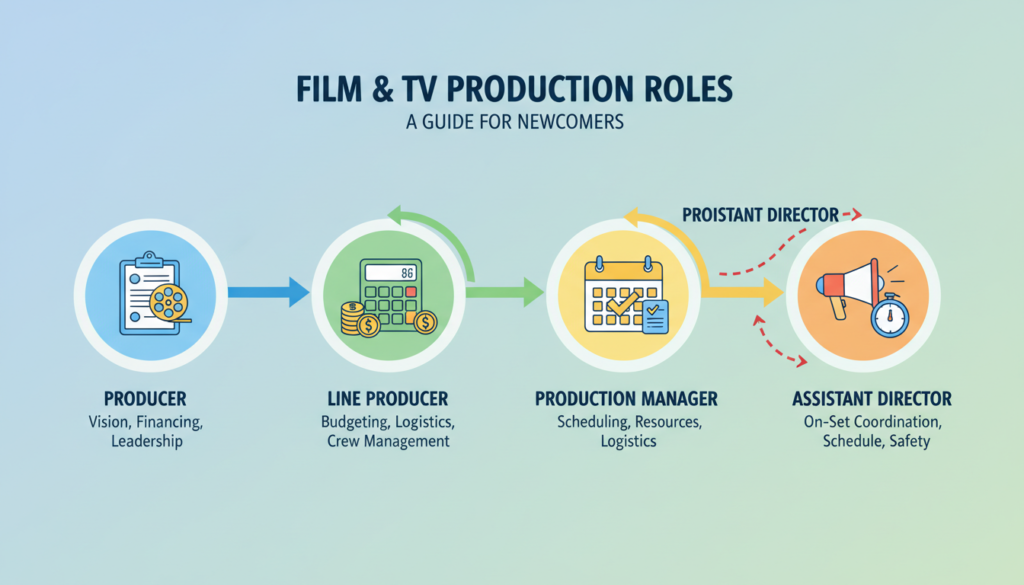
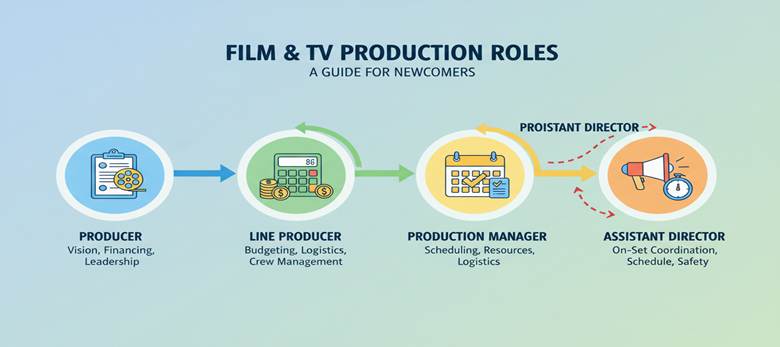
assistant directorWhile distinct, the roles of Producer, Line Producer, Production Manager, and Assistant Director are deeply interconnected. The Producer sets the vision and secures resources, the Line Producer turns vision into a feasible plan, the production manager executes the logistics, and the Assistant Director manages the daily operations on set. Their collaboration ensures that creative ambitions are realized efficiently and effectively.
producerExample of Collaboration:
On a high-budget TV series, the producer might secure a star actor and negotiate with the network. The line producer builds a budget and hires department heads, the production manager arranges international locations and logistics, and the assistant director ensures each day’s shoot runs to plan. If an unexpected storm delays shooting, the AD works with the production manager to adjust the schedule, the line producer balances the budget impact, and the Producer communicates with financiers.
Conclusion
assistant director. The journey from script to screen involves the vision and expertise of many, but none are more pivotal than the producer, line producer, production manager, and assistant director. Each role brings specialized skills—ranging from strategic leadership and financial acumen to logistical mastery and set management. Through real-world case studies such as “The Lord of the Rings,” “Slumdog Millionaire,” “The Revenant,” and “Mad Max: Fury Road,” we see how their efforts are vital in navigating creative, financial, and practical challenges. Their collaboration transforms ideas into cinematic reality, ensuring that every film or show reaches its audience with maximum impact. In the ever-changing landscape of film and television, these roles remain the foundation upon which successful productions are built.