Introduction to Project Management in Film
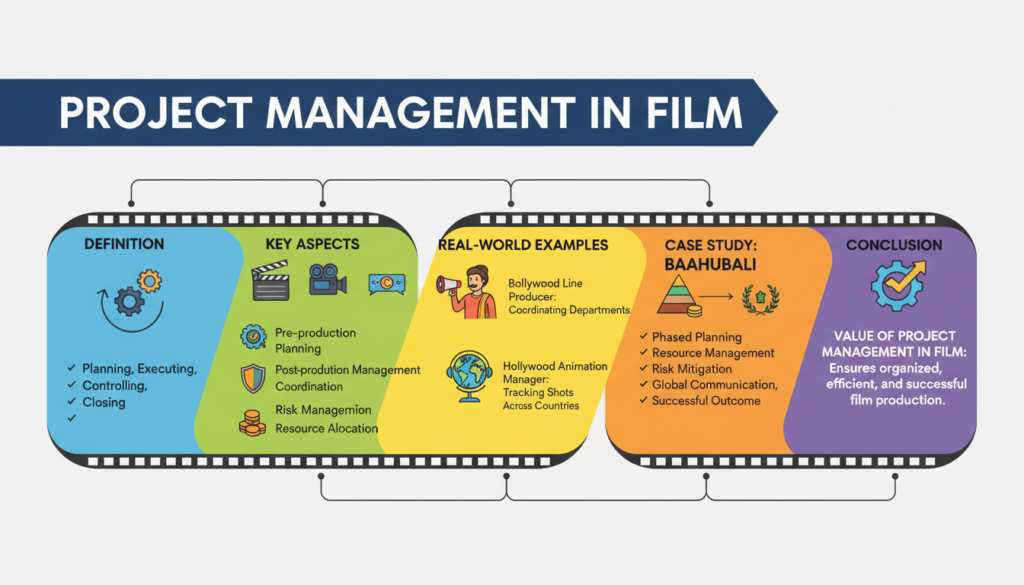
Project management in film refers to the structured process of planning, executing, controlling, and closing all phases of a film project to achieve artistic and business goals on time and within budget. Film projects are large, complex undertakings involving creative, technical, and logistical elements—making project management essential for success.
Key Aspects of Project Management in Film
- Pre-Production Planning:
This stage involves script finalization, budgeting, scheduling, casting, hiring crew, and securing locations. Detailed planning helps prevent delays and budget overruns. - and equipment, andequipment; andand equipment;and equipment; Production Management:
Oversees the day-to-day shoot; manages personnel, logistics, equipment, and ensures the project stays on schedule and within budget. - effects andPost-Production Coordination:
Manages editing, sound design, and visual effects, and prepares the final product for release. - Risk Management:
Identifies potential risks (weather, actor availability, equipment failure) and prepares contingency plans. - Communication:
Maintains clear channels among producers, directors, crew, and stakeholders. - Resource Allocation:
Ensures efficient use of money, time, and human resources.
Examples
- Example 1:
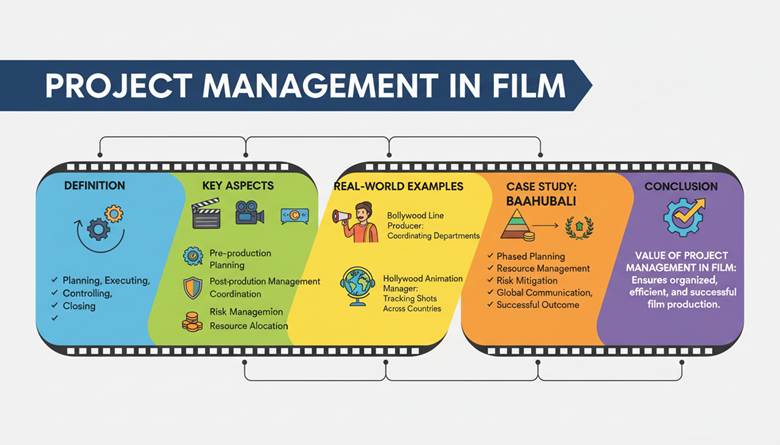
In a Bollywood film, the project manager (often called a line producer) coordinates between different departments, ensures the shooting schedule is realistic, and solves on-set challenges such as location permits or weather disruptions. - Example 2:
In a Hollywood animation project, a project manager uses specialized software to track progress on thousands of individual shots, managing communication between animators, editors, and sound designers across multiple countries.
Case Study: Project Management in the Making of “Baahubali: The Beginning” (2015)
Background:
“Baahubali: The Beginning” was one of India’s most ambitious and expensive films. It involved thousands of crew members, complex visual effects, and a multi-year production timeline.
How Project Management Played a Role:
- Planning & Scheduling:
The producers broke the project into phases: scriptwriting, casting, VFX design, set construction, filming, and post-production. Each phase had a dedicated schedule and budget. - Management: resources Resources needed, available when needed: Resource Management: resources needed Resources needed available when needed Resource Management:
Massive sets were constructed, and hundreds of extras were coordinated for battle scenes. The project manager ensured that resources (costumes, props, equipment) were in the right place at the right time. - Risk Mitigation:
Weather delays and injuries were anticipated. Backup plans were in place, such as alternate shooting schedules and medical support on set. - aligned, aligned, aligned, aligned. Everyone communicated by holding regular video conferences and tracking progress to keep everyone aligned. everyone communicating: Held regular video conferences and tracked progress to keep everyone communicating:
With VFX work spread across studios in different countries, the project manager established regular video conferences and progress tracking to ensure everyone was aligned. - quality, demonstratingOutcome:
The film was delivered on time and became a blockbuster, setting new standards for Indian cinema production quality—demonstrating the value of strong project management.
Conclusion:
Project management in film ensures that creative vision is realized efficiently and professionally, reducing risks, controlling costs, and delivering successful films—even on the largest and most complex productions.
Production Management: Meaning, Introduction, and Example
PRODUCTION MANAGEMENT
Meaning
Production management refers to the process of planning, organizing, directing, and controlling the production activities in an organization. Its main goal is to efficiently transform raw materials, resources, and labor into finished products or services that meet quality standards, deadlines, and cost targets.
Introduction
production management, Management, management, production management, management Production managementProduction management Production management is fundamental in industries such as manufacturing, media, film, and services. It ensures that every step of the production process—whether making cars, movies, or digital content—achieves maximum efficiency and effectiveness. This includes:
- Planning what to produce, when, and how.
- Organizing resources (people, equipment, materials).
- Directing staff and coordinating workflow are also key responsibilities. Directing staff and coordinating workflow.
- Controlling quality, costs, timing, and output.
In the media and film industry, production management involves everything from script breakdowns, scheduling, and budgeting to coordination on set and post-production oversight.
Example
Example: Film Production Management
A production manager for a feature film:
- Plans the entire shooting schedule based on script needs and artist availability.
- Organizes the hiring of crew, booking of equipment, and securing locations.
- planned. planned. Directs daily operations on set, ensuring the team shoots scenes as planned. Directs daily operations on set, ensuring the team shoots scenes as planned.
- Controls the budget, monitors costs, ensures timely delivery of footage, and resolves on-set issues.
By handling these responsibilities, the production manager ensures the film is completed on time, within budget, and at the desired quality—essential for the project’s success.