A. Editing
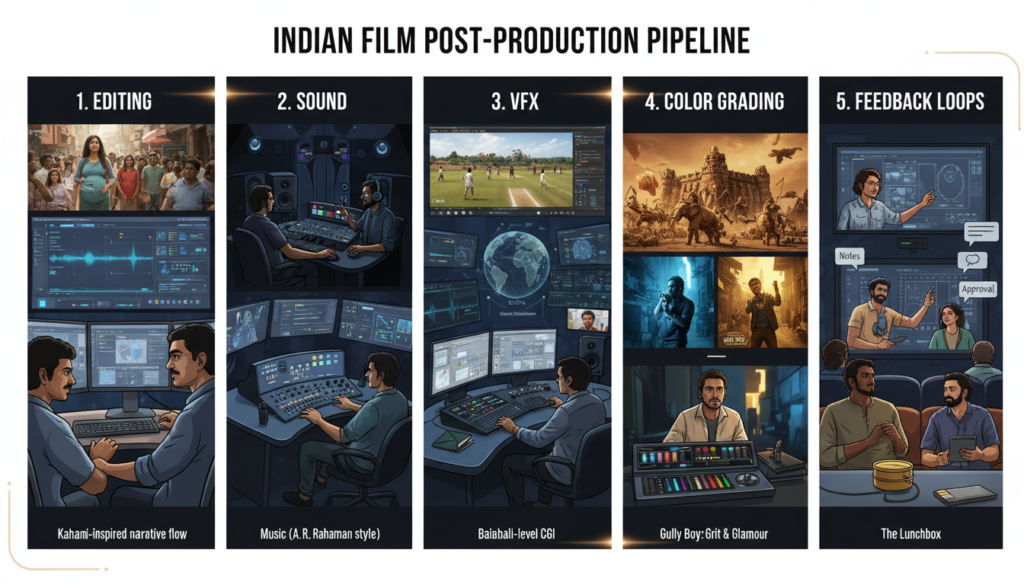
Editing shapes the final narrative, pace, and emotional impact of the film.
Stages:
- Assembly Edit: All footage is organized per script and storyboard, using the director’s notes and performance logs.
- Rough Cut: Major scenes are blocked out, with placeholder music and sound effects.
- Fine Cut: Timing and transitions are refined, and the director approves the main narrative flow.
Example: “Kahaani” (2012) Editor Namrata Rao played a key role in maintaining the suspenseful, nonlinear structure of “Kahaani.” Performance logs and shot breakdowns allowed for efficient decision-making, especially for scenes shot in the chaotic streets of Kolkata.
B. Sound
Sound editing and mixing are crucial, especially in Indian cinema, where music, dialogue, and ambient sound are central.
Process:
- Dialogue Editing: Cleaning, syncing, and sometimes re-recording (ADR) to ensure clarity.
- Sound Effects and Foley: Adding footsteps, background noise, and atmosphere to enhance realism.
- Music Integration: Background score and songs are woven into the edit.
- Mixing: Final balance and surround sound formatting.
Indian Example: “Lagaan” (2001) The cricket match sequences required detailed sound design, from bat hits to crowd noise. The mixing team layered multiple audio sources to create an immersive experience that became a hallmark of the film.
C. Visual Effects (VFX)
Indian films increasingly use VFX to create larger-than-life visuals, from subtle enhancements to fully digital environments.
Workflow:
- Pre-Visualization: Storyboards and pre-viz animatics guide both shooting and VFX.
- Plate Delivery: Clean shots are delivered to VFX vendors with reference data (camera movement, lighting).
- CGI Integration: Digital assets are integrated, composited, and matched for color and lighting.
- Review and Feedback: Multiple rounds of feedback between the director, VFX supervisor, and vendors.
Case Study: “Baahubali: The Conclusion” (2017) Over 35 VFX studios worldwide worked on “Baahubali,” making it India’s most VFX-heavy film at the time. The production set up a centralized VFX studio to coordinate assets, manage feedback, and ensure consistency. Frequent reviews with director S.S. Rajamouli ensured creative alignment, and dailies from VFX vendors were integrated into the editing timeline for ongoing assessment.
D. Color Grading
Color grading unifies the visual tone and style of the film, balancing exposure, color temperature, and mood.
Process:
- Primary Grade: Basic correction for consistency and exposure.
- Secondary Grade: Fine-tuning specific tones and areas (e.g., making costumes pop, enhancing sunset scenes).
- Creative Grade: Applying LUTs (Look-Up Tables) or custom looks for stylization.
Example: “Gully Boy” (2019) Colorist Ken Metzker used grading to distinguish between the gritty Mumbai slums, performance spaces, and aspirational moments, giving each narrative phase a distinct emotional flavor.
E. Feedback Loops
Continuous feedback is essential for quality control and creative alignment in post-production.
Mechanisms:
- Internal Reviews: Editors, directors, and department heads conduct regular screenings and critiques.
- Test Screenings: Sample audiences provide insights on pacing, clarity, and emotional impact.
- Remote Collaboration: In the COVID era, cloud-based editing suites and video conferencing enabled remote feedback for films like “Shershaah” (2021).
Indian Example: “The Lunchbox” (2013) Director Ritesh Batra held multiple feedback screenings, tweaking the edit and sound based on audience reactions. This iterative process helped the film achieve international acclaim and box office success.
IV. Integrated Case Study: The Making of “Baahubali: The Conclusion”
“Baahubali: The Conclusion” (2017) is a landmark in Indian cinema, not just for its scale and storytelling but for its meticulous management of production and post-production workflows.
Pre-Production
- Shot Breakdown: Every major scene (battlefields, waterfalls, palaces) was visualized and planned with VFX requirements in mind.
- Scheduling: Filming was scheduled to maximize set usage and cast availability, often shooting out of sequence to accommodate complex VFX and actor schedules.
On-Set Workflow
- Dailies and Performance Logs: Scenes involving motion capture and green screens were reviewed daily for technical quality and performance nuance.
- Cross-Department Coordination: VFX supervisors, set designers, costume heads, and camera teams worked in tandem, using shared digital documentation.
Time & Cost Management
- Budgeting: With a budget exceeding ₹250 crore, rigorous tracking of daily spends and resource deployment was essential.
- Contingency Planning: The team factored in allowances for weather, reshoots, and VFX overruns.
Post-Production Pipeline
- Editing: Real-time integration of VFX elements into the edit allowed the director to visualize progress and make informed creative decisions.
- Sound & Music: M.M. Keeravani’s score was composed in parallel with editing, and sound design evolved to match the movie’s epic tone.
- VFX: Over 4,500 shots involved VFX, coordinated across global vendors using cloud-based asset management.
- Color Grading: Final grade unified the film’s look, blending digital and live-action elements seamlessly.
Communication & Feedback
- Regular Sync-Ups: Weekly video conferences linked teams in Hyderabad, Mumbai, Los Angeles, and London.
- Director’s Approval: S.S. Rajamouli personally reviewed key sequences, ensuring his vision was realized.
Outcome
“Baahubali: The Conclusion” became one of India’s highest-grossing films, earning praise for its technical excellence. Its success is attributed to disciplined workflow management, cross-departmental communication, and a relentless focus on quality at every stage.
V. Challenges and Evolving Best Practices in Indian Film Workflows
Common Challenges
- Scale and Complexity: As productions become bigger, coordinating hundreds of crew and global VFX vendors is increasingly complex.
- Technology Gaps: Smaller productions may lack access to advanced project management, asset tracking, or cloud collaboration tools.
- Budget Overruns: Unplanned delays, weather, or creative changes can strain budgets.
- Cultural Hurdles: Traditional, hierarchical structures can slow decision-making and feedback loops.
Evolving Best Practices
- Previsualization and Planning: Indian productions increasingly use digital pre-viz, animatics, and detailed script breakdowns to minimize surprises on set.
- Digital Asset Management: Cloud-based tools enable sharing, tracking, and securing scripts, dailies, and VFX assets.
- Agile Workflows: Shorter feedback cycles and adaptive scheduling help teams respond to challenges in real time.
- Professionalization: Increased use of trained line producers, production managers, and workflow consultants.
- Remote and Virtual Post: COVID-19 accelerated the adoption of remote editing, color grading, and feedback sessions.
Conclusion
The evolution of Indian filmmaking, from tightly scheduled studio shoots to sprawling, multi-unit, VFX-driven productions, has made workflow management central to creative and commercial success. Films like “Baahubali,” “Padmaavat,” “2.0,” and “Gully Boy” exemplify how meticulous shot breakdowns, diligent daily reviews, robust communication, and integrated post-production pipelines are essential. As Indian cinema continues to raise its global profile, mastering these workflows will be the backbone that supports its most ambitious storytelling.