A. Time and Cost Tracking
Managing budgets and timelines is critical, especially when productions involve elaborate sets, multiple locations, and expensive VFX or star casts.
Tools & Methods:
- Production Management Software: Indian productions increasingly use tools like Movie Magic Scheduling/Budgeting, Shotgun, or custom solutions to track expenses and timelines.
- Daily Production Reports: ADs and production managers submit reports detailing shots completed, work hours, and resource usage.
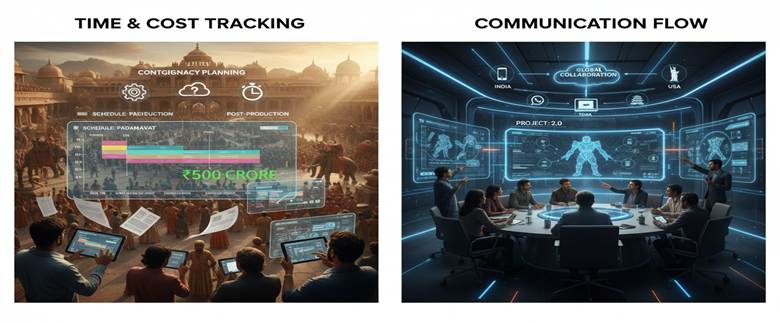
- Contingency Planning: Budgets include buffers for weather delays, reshoots, or technical glitches.
Case Study: “Padmaavat” (2018) Sanjay Leela Bhansali’s “Padmaavat” faced numerous challenges—delays due to protests, elaborate set construction, and reshoots. The production team’s rigorous cost and time tracking allowed them to manage overruns and reallocate resources, ensuring completion without compromising on quality.
B. Communication Flow Between Departments
Filmmaking is inherently collaborative, requiring seamless coordination between creative, technical, and logistical departments.
Key Aspects:
- Department Heads: Each department (direction, camera, art, sound, VFX, costume, etc.) has a head who reports to the line producer or director.
- Daily Briefings: Short meetings align all teams on the day’s objectives, changes, and challenges.
- Digital Communication: WhatsApp, Slack, and project management apps are increasingly common on Indian sets. For bigger productions, dedicated intranets or cloud documentation platforms are used.
Case Study: “2.0” (2018) Shankar’s “2.0” was India’s most expensive film at the time, with extensive practical effects, CGI, and robotics. Coordinating between live-action crews and international VFX vendors (including studios in the US and Hong Kong) required real-time communication platforms, detailed shot documentation, and frequent review sessions. The production used cloud-based asset management to share references and updates across continents.