Introduction
Resource allocation is at the heart of every successful film project. Regardless of the budget or scale, the careful planning and strategic deployment of crew, equipment, locations, and legal compliance determine whether a film can be delivered on time, within budget, and to the desired creative standard. This essay explores these pillars of film project management, using recent examples and case studies from Indian and global cinema to support its analysis.
1. Crew Allocation
Importance and Structure
A film crew is the engine powering a project. Effective crew allocation ensures that specialists in their field handle each technical and creative task. The core crew is usually divided into the following:
- Production: Producer, line producer, production manager, and assistant directors.
- Camera and Lighting: Director of photography (DP), camera operators, gaffers, grips.
- Sound: Sound recordist, boom operator, and sound assistants.
- Art Department: Production designer, art director, set decorators, and prop masters.
- Costume and Makeup: Costume designer, makeup and hair artists.
- Post-Production: Editors, VFX artists, sound designers, and color graders.
- Support: Runners, drivers, catering, medical team, security.
Example: Crew Allocation in “Jawan” (2023, India)
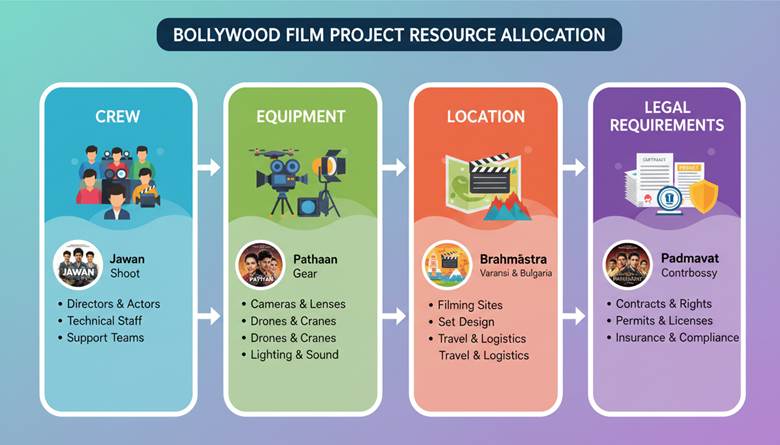
Shah Rukh Khan’s hit film “Jawan” required a vast crew, including action directors from South India, international stunt teams, and a large post-production VFX unit. The project’s complexity meant multiple units worked in parallel, and specialized talent was sourced globally for action sequences and special effects.
Best Practices
- Match roles with skills and experience (e.g., hiring a DP experienced in action for high-octane films).
- Ensure communication and clear reporting lines between departments.
- Maintain backup plans for illness or emergencies (e.g., second unit directors).
- Foster crew morale with fair compensation, rest breaks, and appropriate working conditions.
Case Study: “RRR” (2022, India)
Director S.S. Rajamouli’s epic “RRR” involved an international crew, including VFX experts from Hollywood. The size and variety of the team required detailed schedules, departmental meetings, and clear communication protocols. This ensured that stunts, VFX, and live action integrated perfectly, resulting in one of the most successful Indian films globally.
2. Equipment Allocation
Identifying Equipment Needs
The right equipment is essential for realizing the director’s vision. This includes:
- Camera Systems: High-end digital cameras (Arri Alexa, RED) for main shooting; GoPros or drones for specialty shots.
- Lighting: LED panels, HMIs, practical lights, and reflectors.
- Sound Gear: Field recorders, boom mics, and wireless lapels.
- Grip: Dollies, jibs, cranes, Steadicams.
- Post-Production: Editing suites, color-grading stations, and VFX workstations.
Example: Equipment Allocation in “Pathaan” (2023, India)
For the blockbuster “Pathaan,” the production used advanced camera rigs for action sequences, drones for aerial shots, and sophisticated sound equipment for immersive audio. The team worked with top rental houses in Mumbai and abroad, securing the latest technology.
Rental vs. Purchase
- Rental: Most productions rent cameras and lights to access the latest gear without long-term costs.
- Purchase: Bigger studios may buy equipment for repeated use.
- Maintenance: Allocating funds for repairs, backups, and technical support.
Logistics
- Transport: Equipment is shipped between locations, sometimes internationally.
- Storage and Security: Proper handling prevents theft and damage.
- On-Set Management: A dedicated technical crew handles setup, operation, and troubleshooting.
Case Study: “Avatar: The Way of Water” (2022, Hollywood)
James Cameron’s sequel pushed technological boundaries with custom underwater camera rigs, motion capture suits, and real-time VFX integration. The production required the coordination of equipment providers worldwide and on-set engineers to maintain highly sensitive gear in challenging environments.
3. Location Allocation
Scouting and Selection
Location managers work with the director and production designer to identify real-world or studio settings that fit the script. Key considerations:
- Visuals: Does the location fit the story’s mood?
- Cost: Rental fees, local taxes, community compensation.
- Logistics: Accessibility for crew and equipment, nearby amenities.
- Support: Cooperation from local authorities and communities.
Example: Location Planning in “Rocky Aur Rani Kii Prem Kahani” (2023, India)
The film used both grand palaces in Rajasthan and real homes in Delhi. With the COVID-19 pandemic, locations were chosen for safety, local medical facilities, and the ability to quarantine a large crew if needed.
Location Logistics
- Permits: Legal permissions from local, state, and national authorities.
- Scheduling: Planning to avoid public crowds, harsh weather, or local events.
- Transport and Accommodation: Moving and housing cast and crew.
- Security: Protecting cast, crew, and equipment.
Case Study: “Dunki” (2024, India/International)
Rajkumar Hirani’s “Dunki,” starring Shah Rukh Khan, was shot across India, the Middle East, and Europe. Each country required separate location permits, customs clearances for equipment, and coordination with local crews. For scenes set in deserts, the team organized water, shade, and emergency medical support to handle extreme conditions.
4. Legal Requirements
Legal Compliance
Films must comply with laws at every stage:
- Intellectual Property: Securing story, script, and music rights.
- Contracts: Legal agreements with cast, crew, and vendors.
- Permits: Government permissions for shooting in public or sensitive locations.
- Labor Laws: Compliance with working hours, union rules, and child actors’ protections.
- Insurance: Covering equipment, staff, third-party claims, and delays.
- Censorship: Submission for certification to CBFC (India) or relevant bodies.
Example: Legal Planning in “The Kerala Story” (2023, India)
The film, inspired by real events, required legal vetting to avoid defamation and ensure privacy rights. Permissions were needed from local authorities for shooting in sensitive areas, and contracts were carefully drafted to avoid later litigation.
Navigating Legal Hurdles
- Delays and Overruns: Missing paperwork or disputes can halt filming.
- Budget Impacts: Unexpected fines or legal costs.
- Reputation: Legal controversies can disrupt releases (e.g., “Padmaavat” bans).
Case Study: “Padmaavat” (2018, India)
Facing violent protests and legal bans in several states, the producers of “Padmaavat” invested in legal teams, public relations, and security. Ultimately, court orders allowed nationwide release, but only after editing contentious scenes and issuing public clarifications.
Case Study: “Brahmāstra: Part One – Shiva” (2022, India)
Crew
With a vision to create India’s first modern fantasy adventure at a global scale, director Ayan Mukerji assembled an international crew: Hollywood VFX supervisors, Bollywood’s leading cinematographers, and experienced action choreographers. The production ran multiple units in parallel for live action, VFX, and stunts. The allocation of crew was vital to coordinate India-based main unit shoots and Los Angeles-based post-production.
Equipment
“Brahmāstra” utilized state-of-the-art cameras, drones, and virtual production equipment similar to what’s used in Marvel movies. Equipment was rented from India, the US, and the UK, with logistics teams managing customs, insurance, and transportation across continents. Specialized technicians traveled with the gear to ensure seamless integration on different sets.
Location
The film shot across Varanasi, Manali, Bulgaria, and Mumbai studios. In Varanasi, the team coordinated with local authorities to shoot in crowded ghats, often filming at dawn for crowd control. In Bulgaria, harsh winter conditions required careful planning for crew safety and equipment protection. In each location, the team organized accommodation and transport for over 300 cast and crew, hiring local fixers to smooth bureaucratic hurdles.
Legal
Given the film’s high profile, legal contracts covered international co-production terms, VFX vendor agreements, and actor exclusivity. The team navigated censorship guidelines to secure a timely release and ensured all music rights (with multiple composers) were legally cleared. Insurance covered delays due to COVID-19 disruptions, with contingency plans for rescheduling.
Outcome
Despite the challenges, “Brahmāstra” was released to wide anticipation, demonstrating how rigorous resource allocation across crew, equipment, location, and legal compliance is essential for ambitious film projects.
Conclusion
Resource allocation in film management is a delicate balance of creativity, logistics, and compliance. Recent movies like “Jawan,” “Pathaan,” “RRR,” “Dunki,” and “Brahmāstra” illustrate the scale and complexity involved in assigning the right crew, securing cutting-edge equipment, managing diverse locations, and navigating legal landscapes. Globalization, new technologies, and evolving regulations mean that successful film project managers must be adaptable, well-informed, and proactive. By learning from recent examples and real-world case studies, future filmmakers and producers can master resource allocation, ensuring their visions become successful, impactful, and memorable cinematic experiences.