Introduction
The microenvironment of a business comprises the internal and near-external factors that directly influence a company’s day-to-day operations and strategic decisions. Unlike the macro environment (which includes large-scale forces like the economy or politics), the micro environment is closer to the company and more controllable. For Indian brands, the microenvironment is shaped by unique market dynamics, management philosophies, and an intricate web of stakeholders and competition.
I. Management Structure
Definition & Importance
Management structure refers to the hierarchy, roles, and reporting relationships within an organization. It dictates how decisions are made, how information flows, and how strategy is executed. The right structure balances control with agility—crucial for Indian firms operating in a fast-changing market.
Common Structures in Indian Businesses
- Hierarchical (Traditional) Structure
- Common in large, established firms and family-owned conglomerates.
- Clear levels of authority.
- Flat Structure
- Fewer layers, more direct communication.
- Common in startups and creative agencies.
- Matrix Structure
- Employees report to multiple managers (e.g., by function and by project).
- Seen in large IT firms and ad agencies.
Indian Brand Example: Reliance Industries
Reliance Industries Ltd (RIL)
- Type: Hierarchical conglomerate structure.
- Details: Chairman and Managing Director Mukesh Ambani leads the company, while separate verticals (petrochemicals, retail, telecom) have their respective CEOs.
- Impact: This structure allowed Reliance to quickly launch Jio by leveraging expertise and resources from other verticals.
Case Study: Amul (Gujarat Cooperative Milk Marketing Federation)
- Structure: Cooperative, three-tiered (village societies, district unions, and state federation).
- How it works: Village-level societies collect milk, run by elected representatives; district unions handle processing; and the state federation (GCMMF) manages marketing and branding.
- Outcome: Enables local empowerment, rapid scaling, and brand consistency, making Amul India’s largest dairy brand.
Takeaways for Indian Firms
- Traditional structures suit large, capital-intensive businesses (Reliance, Tata).
- Flat structures empower innovation (Flipkart and Zomato in their early days).
- Cooperatives and hybrid structures can harness local talent and scale (Amul).
II. Marketing Channels
Definition & Importance
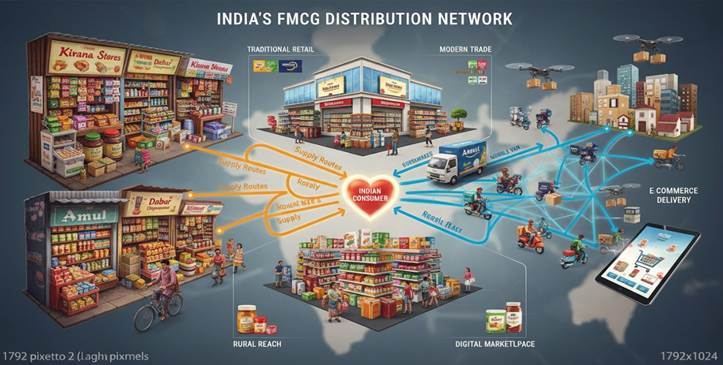
Marketing channels are the avenues through which products or services reach consumers. They can be direct (company to customer) or indirect (using distributors, retailers, and agents). In India, due to its vast geography and diversity, channel choice is a key competitive differentiator.
Types of Marketing Channels in India
- Direct-to-Consumer (D2C) / E-Commerce
- Selling via a brand website, apps, or platforms like Amazon or Flipkart.
- Retail Channels
- Modern trade: Supermarkets, hypermarkets (Big Bazaar, D-Mart).
- Traditional trade: Kirana stores, local markets.
- Distribution Networks
- Layers of distributors, stockists, wholesalers, and retailers—especially in rural areas.
- Hybrid Channels
- A mix of online and offline methods is often used, particularly in FMCG and apparel.
Indian Brand Example: Dabur India Ltd
- Urban Markets: Dabur sells its products through modern retail outlets (Reliance Fresh, Nature’s Basket), pharmacies, and its own website and e-commerce platforms.
- Rural Markets: Dabur has one of India’s largest rural distribution networks, reaching over 6 million outlets, using regional distributors and local vans.
Case Study: Big Bazaar (Future Group)
- Strategy: Combined international-style supermarkets with Indian pricing, festival offers, and local product mix.
- Channels: Sourced directly from farmers and manufacturers, centrally warehoused, and distributed to stores nationwide.
- Outcome: Transformed Indian grocery shopping for middle-class families and created a new retail format until its acquisition and integration into Reliance Retail.
Case Study: boAt (D2C Electronics Brand)
- Channel Focus: Initially sold exclusively through e-commerce platforms (Amazon, Flipkart), then expanded to its website and select retail partnerships.
- Result: Fast sales growth, direct customer engagement, and cost savings on intermediaries.
Channel Challenges & Innovations
- Rural reach: Brands like Colgate and HUL use “last-mile” distribution and mobile vans.
- Omnichannel: Titan’s Tanishq uses both exclusive stores and e-commerce, giving customers flexibility.
- Digital Payments: The rise of UPI and mobile wallets has revolutionized how small-format retailers transact.
III. Markets in Which a Firm Operates
Definition & Types
A market is a group of potential buyers with needs/wants that a company’s offerings can satisfy. For Indian businesses, understanding market segmentation is essential due to the country’s diversity.
Types of Markets
- Consumer Markets: Selling directly to end-users (e.g., HUL, Amul).
- Business Markets: B2B sales (e.g., Tata Steel to automakers, L&T to infra companies).
- Government Markets: Supplying to government agencies (e.g., Bharat Electronics to Indian Army).
- International Markets: Exports/operations abroad (e.g., Infosys, Tata Motors).
Indian Brand Example: Tata Motors
- Consumer Market: Sells cars like Tiago and Nexon to individual buyers.
- Business Market: Sells buses and trucks to logistics firms and state transport.
- International Market: Exports vehicles to Africa, Southeast Asia, and Europe.
Case Study: Zomato
- Consumer Market: Food ordering app for end users.
- Business Market: Logistics for restaurants, cloud kitchens.
- International Market: Operated in UAE, Southeast Asia, and others before focusing back on India.
- Government Market: Partnered with state agencies during COVID-19 relief.
Case Study: Infosys
- B2B Market: Provides IT services to Fortune 500 companies globally.
- Government Market: IT solutions for Indian government projects (e.g., GSTN, passport seva).
- Consumer Market: Through its fintech arm, it offers banking solutions to end users.
Key Considerations for Indian Firms
- Urban vs. Rural: Product size, pricing, and communication change drastically.
- Tiered Cities: Brands often launch in metros before expanding to Tier 2/3 cities.
- Regulatory Requirements: Entering government markets requires compliance and certifications.
IV. Competitors
Definition & Types
Competitors are firms vying for the same customer base, either with similar products (direct) or substitutable products/services (indirect).
Types of Competition
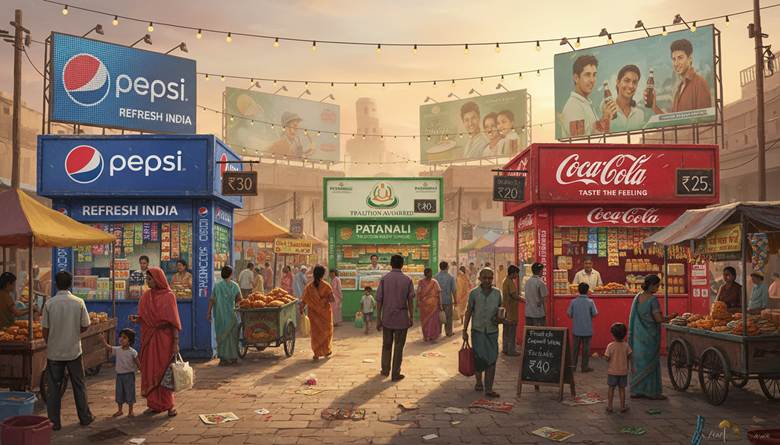
- Direct: Same products (e.g., Pepsi vs. Coca-Cola).
- Indirect: Different products serving the same need (e.g., Domino’s Pizza vs. Swiggy for quick meals).
- Potential Entrants: New startups, international brands entering the market.
Indian Brand Example: Ola vs. Uber
- Ola: Indian ride-hailing app, localized features (auto-rickshaw bookings, regional language support).
- Uber: US-based, expanded in India with aggressive pricing and partnerships.
- Competition: Led to innovation in payments (Ola Money, Uber’s integration with Paytm), safety features, and new services (Ola Electric, Uber Eats before acquisition).
Case Study: Patanjali Ayurved’s Disruption
- Background: Entered the FMCG market with herbal and Ayurvedic products.
- Strategy: Swadeshi positioning, rapid product launches, and cost leadership.
- Impact: Captured market share in toothpaste, ghee, and health drinks, challenging established giants like HUL and Dabur.
- Outcome: Forced incumbents to launch “natural” product lines and rethink pricing.
Case Study: Jio vs. Airtel/Vodafone
- Jio’s Entry: Free data, low prices, extensive 4G rollout.
- Competitor Response: Airtel and Vodafone had to cut prices and invest in network upgrades.
- Market Impact: Industry consolidation, innovation in digital services, and a massive jump in India’s internet subscriber base.
Competitive Strategies in India
- Local Adaptation: McDonald’s “Maharaja Mac” and “McAloo Tikki” for Indian tastes.
- Pricing Wars: Aggressive discounts in e-commerce (Amazon vs. Flipkart).
- Innovation: Zomato’s hyperlocal delivery and Swiggy’s Instamart for groceries.
V. Stakeholders
Definition & Types
Stakeholders are any individuals, groups, or organizations that affect or are affected by a firm’s activities.
Types of Stakeholders
- Internal: Employees, management, owners.
- External: Customers, suppliers, distributors, government, NGOs, investors, community.
Indian Brand Example: Infosys
- Employees: Learning and development programs, ESOPs.
- Investors: Transparent communication, regular dividends.
- Clients: Focus on quality and innovation.
- Government: Compliance, tax payments, CSR initiatives.
Case Study: Nestlé India and the Maggi Crisis
- Crisis: Maggi noodles banned for alleged excess lead content in 2015.
- Stakeholder Response:
- Consumers: Addressed safety concerns via transparent communication.
- Retailers: Managed product recalls efficiently.
- Government: Cooperated with regulatory authorities.
- Media/Public: Regular updates and a campaign for relaunch.
- Outcome: After months of testing and assurance, Maggi returned to shelves and recaptured market share, demonstrating strong stakeholder management.
Case Study: Tata Group’s COVID-19 Response
- Stakeholders Engaged: Employees (job security), customers (essential services), government (healthcare donations), and community (free meals, PPE supply).
- Result: Enhanced trust and reputation across stakeholder groups.
VI. Integration: How the Microenvironment Shapes Indian Business Success
Amul—A Microenvironment Success Story
- Management: Cooperative, decentralized, yet coordinated.
- Channels: Massive distribution—urban supermarkets to rural kiranas.
- Markets: Dairy, beverages, ice cream, global exports.
- Competitors: Regional brands, private players, multinationals.
- Stakeholders: 3.6 million milk producers, employees, suppliers, and consumers.
Impact:
Amul’s ability to align all elements of its microenvironment has helped it become India’s most trusted food brand, resilient to competition and economic changes.
Strategic Takeaways for Indian Companies
- Structure for Scale and Agility: Choose a management system that matches your growth ambitions and market realities.
- Channel Innovation: Leverage both traditional and digital channels to maximize reach.
- Market Focus: Customize products and marketing for different segments (urban/rural, B2B/B2C).
- Competitive Edge: Monitor and react to competitor moves rapidly.
- Stakeholder Engagement: Build lasting relationships with all key groups, especially during crises.
Conclusion
The microenvironment—comprising management structure, marketing channels, markets, competitors, and stakeholders—forms the “engine room” of every successful Indian business.
By studying the journeys of Amul, Reliance, Ola, Nestlé, Dabur, Tata Motors, and more, we see that Indian brands thrive when they align their internal strengths and networks with the diverse needs and expectations of the Indian market.
In a fast-changing economy, the mastery of the microenvironment is what empowers Indian businesses to innovate, scale, and withstand external shocks—setting the stage for national and global leadership.