Introduction
The Indian film industry, spanning Bollywood, South Indian cinema, and regional film centers, has undergone profound transformation in its approach to managing film workflows. The complexity and scale of modern Indian productions, especially those with high budgets or ambitious visual effects (VFX), demand meticulous management of on-set processes, time and cost tracking, and post-production integration. This essay will examine the details of on-set workflows (shot breakdowns, dailies, performance logs), cross-departmental communication and resource management, and the post-production pipeline, using landmark Indian films as case studies to illustrate best practices and challenges.
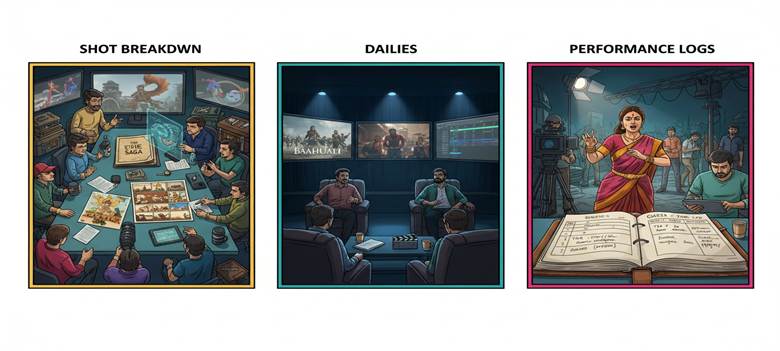
I. Managing On-Set Workflows: Shot Breakdowns, Dailies, Performance Logs
A. Shot Breakdowns
A shot breakdown is the foundation of every organized film production. It involves dissecting the script into individual shots, detailing location, cast, props, VFX requirements, camera setups, lighting, and other logistical elements for each scene.
Key Steps:
- Script Analysis: Assistant directors (ADs) work with the director and cinematographer to analyze the script, identifying each shot’s specific needs.
- Breakdown Sheets: Each scene is broken down into a shot list, specifying requirements for costumes, props, VFX markers, stunts, and more.
- Scheduling: Shots are grouped for efficiency (by location, cast availability, or technical needs), and shooting schedules are created.
Indian Example: “Baahubali” Series S.S. Rajamouli’s “Baahubali” films, among the most ambitious Indian movies ever made, required extensive pre-visualization and detailed shot breakdowns. Given the heavy reliance on VFX, each scene was storyboarded, with VFX supervisors involved from the outset to ensure that live-action and digital elements would integrate seamlessly. The production team used specialized software to manage shot lists and coordinate between Hyderabad’s Ramoji Film City sets and multiple VFX vendors.
B. Dailies
Dailies (or rushes) are the raw, unedited footage shot each day. Reviewing dailies is crucial for quality control, early error detection, and creative alignment.
Process:
- Transfer and Sync: After shooting, footage is transferred to secure storage, synced with sound, and backed up.
- Review: The director, cinematographer, and editors review dailies to assess performances, technical quality (focus, lighting), and continuity.
- Feedback: Quick feedback loops allow for reshoots or adjustments while the set is still available.
Case Study: “Gully Boy” (2019) Director Zoya Akhtar and cinematographer Jay Oza relied heavily on daily reviews. With many real-location shoots in Mumbai and performances blending scripted and improvised elements (especially in rap battle scenes), checking dailies ensured that performances and technical aspects met the desired standard. Dailies also helped the sound team spot and fix audio issues caused by uncontrolled urban environments.
C. Performance Logs
Performance logs are records of actors’ performances, noting the best takes, improvisations, and director’s comments.
Benefits:
- Reference for Editors: Editors use performance logs to identify preferred takes, saving time in post-production.
- Continuity: Logs help maintain consistency across scenes shot out of sequence.
- Actor Feedback: Directors can review and discuss performances with actors, fostering improvement.
Indian Example: “Queen” (2014) Director Vikas Bahl encouraged Kangana Ranaut to improvise, resulting in several spontaneous moments. Performance logs tracked these improvisations, helping editors and the director weave the best takes into the final narrative.