Sales promotion management
- The scope and role of sales promotion
- Reasons for the increase in sales promotion
- Objective of trade-oriented sales promotion
- Techniques of trade-oriented sales promotion
- Objectives of consumer-oriented sales promotion
- Techniques of consumer-oriented sales promotion
Introduction
Sales promotion is an element of the marketing mix. It is an initiative undertaken by the organization to promote an increase in sales. It is mainly used by a wide range of organizations in both the consumer and business markets; however, the frequency and spending levels are much greater for consumer products marketers.
By offering additional value beyond the product’s inherent value at its normal price, sales promotion provides a direct incentive for action. These temporary incentives are generally accessible at a time and place where the buying decision is made. Sales promotion includes several communication activities that attempt to provide added value or incentives to consumers, wholesalers, retailers, or other organizational customers to stimulate immediate sales.
Definition
The American Marketing Association (AMA), in its Web-based “Dictionary of Marketing Terms,” defines sales promotion as “media and non-media marketing pressure applied for a predetermined, limited period of time to stimulate trial, increase consumer demand, or improve product availability.”
A. THE SCOPE AND ROLE OF SALES PROMOTION
- Direct influence: It gives direct encouragement to the consumers to take instant action.
- Better incentive: It provides a stronger motivation for consumers to make a purchase. Here we can say that it acts as a demand creator.
- Flexible in nature: It can be used at any stage of an existing product or a new product promotion.
- Increase sales: Sales promotions can take the form of discounts, percentage-off deals, rebates, and other methods to increase instant sales volume.
- Clear extra bulk: Companies also use sales promotions to clear out excess bulk at the end of a season.
- Cross-Selling: Sales promotions also support upselling, where you encourage a customer to buy a more expensive item, and cross-selling, where you sell an associated product to the customer.
- Brand switching: Sales promotions inspire consumers to buy a more diverse brand than the one they accepted earlier.
- Target audience: You can target specific groups, especially selected retailers and their customers, with sales promotions.
- Many sales promotion schemes either directly or indirectly enhance a firm’s reputation in the market.
B. REASONS FOR THE INCREASE IN SALES PROMOTION
- The growing power of retailers: Nowadays, the power shift in the marketplace is from producers to retailers. Retailers are providing ease of purchasing in retail stores through an advent of technology with optical checkout scanners, consolidation of grocery items at one place, and the evolution of modern barcode private labels for each product with efficient customer service.
- Brand spread and new creation: A most important aspect of several firms’ marketing policies over the past decade has been the advancement of new products. Even retailers and middlemen are demanding more rewards from manufacturers.
- Reinforced reward: Sales promotions that reinforce consumers’ loyalty through discounts and vouchers encourage them to return for the same offers.
- Cost-effective: Usually traditional methods of advertising, like newspaper, radio, television, etc., have high costs of media advertising; due to this, marketers are trying to find out more cost-effective forms of sales promotion.
- Create goodwill: Many sales promotion schemes directly or indirectly increase the goodwill of a firm in the market.
- Attract more buyers: Sales promotion encourages impulse buying and attracts buyers by repeating a visit from first-time buyers.
- Declining brand loyalty: When making purchases, consumers prioritize price, value, and convenience over brand loyalty. Loyal customers are those who are ready to buy a specific brand in spite of high cost without any promotional offer. However, the continuous growth of retail marketing with e-marketing makes consumers more focused on the same specific brand, seeing discounts and offers. For example, many retailers, stores, and e-marketing websites provide discount offers on MRP or fixed prices.
- Short-term focus: Sales promotion is made up of short-term incentives to encourage purchase or sales of a product or service.
- Immediate buying: Advertising gives a reason to buy a product or service, but sales promotion offers an immediate buying reason for a product or service through an eye-catching offer with limited times.
- Fragmentation of the consumer markets: As consumers become more fragmented, they increasingly focus on alternative tailoring methods to reach them, rather than relying on traditional media. Now marketers or advertisers are more into regional and local marketing techniques to reach consumers directly in their place of locality.
- Increased accountability: Modern markets are more competitive; due to this, many companies are demanding real-time data or value for their promotions. Generally, advertising methods like television, radio, etc. are not in a position to provide actual reach and conversion numbers to the company. However, sales promotions are easier and more accurate than those from advertising because they tailor to local markets that vary minutely.
- Consumer acceptance: A competition strengthens and promotion multiplies; consumers have learned to earn the rewards of being smart purchasers.
C. OBJECTIVE OF TRADE-ORIENTED SALES PROMOTION
Sales promotion is a mixture of marketing activities and promotional substances to strengthen the efforts of the sales force or encourage intermediaries to stock and sell particular brand products in their store. It also encourages them to motivate or influence customers to purchase the offering within a specified or limited time.
- It encourages the retailers to carry new items and more inventories.
- It encourages retailers to buy into the future.
- It encourages retailers to advertise the product and give it more shelf space.
- It encourages the sales force to move slow, heartrending products.
- It encourages the sales force to discover and succeed with new prospects.
- It encourages setting up more store display promotions.
D. TECHNIQUES OF TRADE-ORIENTED SALES PROMOTION
- Point Of Purchase Displays: This comprises providing free point of purchase (POP) display units to the retailers to increase their sales.
- Dealer load or display: A dealer loader is a reward that is given to retailers to buy a minimum amount or to install an in-store display.
- Push Money: Extra commission for salespeople and distribution partners to increase sales volume.
- Trade allowances: Discounts given to distribution partners such as retailers to encourage them to stock up on your product.
- Trade Deals: These are special concessions provided to the merchants to encourage them to promote a specific product and increase its sales for a limited time.
- Trade Shows: Trade shows are a powerful sales promotion strategy where the business promotes its product to thousands of traders at the trade show.
E. OBJECTIVES OF CONSUMER-ORIENTED SALES PROMOTION
Sales promotions aim to accomplish various objectives. You can use consumer promotions to boost short-term sales or contribute to establishing a long-term market share. Objectives of consumer-oriented sales promotions are:
- It encourages consumers to try a new product.
- It encourages the continuous purchase of a settled product.
- It pulls consumers away from competitors’ brands or products.
- It holds and rewards loyal customers.
- It motivates consumers to purchase large volumes.
- It helps to create a habit of purchasing on a regular basis.
- It creates positive feelings toward a particular brand or product, which is ultimately connected with their incentives, such as discounts and offers.
F. TECHNIQUES OF CONSUMER-ORIENTED SALES PROMOTION
- Samples: Samples are one of the most important tools of sales promotion. Samples are defined as offers to consumers of a small amount of a product for trial.
- Offering a free gift is a straightforward strategy that attracts potential customers. The offer is usually combined with a specific purchase.
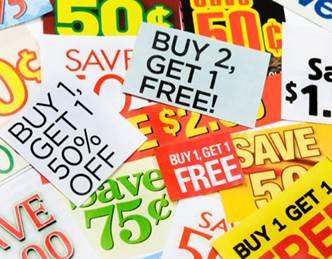
- Discount coupons are an effective method for increasing short-term sales. People go for discount coupons as they let them buy the products they couldn’t afford otherwise.
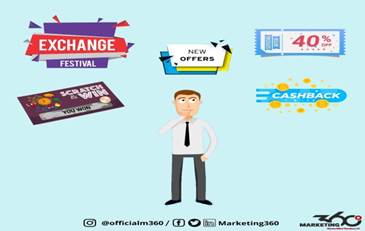
- Exchange schemes attract many customers because they receive some value for their old products.
- Free Shipping for Online Sales: Free shipping makes shopping more eye-catching. When consumers don’t need to worry about the added cost of shipping, the convenience of shopping while staying home becomes attractive.
- makeFinance Schemes: Finance schemes like no-cost EMI, low-interest EMI, etc. make it easier for customers to purchase expensive products.
- Bonus-pack deal: This means that a customer can get more products for the original price.
- Bulk Purchase Deals: Bulk purchase promotions give consumers a deal for buying more of a product. Grocery stores are famous for discounting products that you buy in higher quantities.
- Cash refund offer: Cash refund offers are rebates allowed based on the price of the product.
- Contests are promotional events that give consumers the chance to win prizes such as cash, trips, or goods.
- The products loyalty reward program means that customers collect points or credits when they purchase specific brand products or services.
Advantages of sales promotion
Disadvantages of sales promotion
- -lived.Short life: Sales promotion activities are temporary and short life.
- Create confusion: Regular customers may have some doubts about quality considerations due to excessive sales promotion.
- Customers perceive the use of sales promotional activity tools as a means of selling inadequate or low-quality products.
- Expensive: It is expensive and leads to a rise in the price of products.
- Reflects crisis: If a firm uses sales promotion tools frequently, it may give the impression that the number of consumers is very low or a firm is unable to manage its sales.
- Separating Customers: With certain types of sales promotions and discounts, it can be difficult to control the nature and timing of purchasing.
- Price compassion: Sales promotion can persuade users to expect a lower price in the future and potentially damage ‘quality.’